


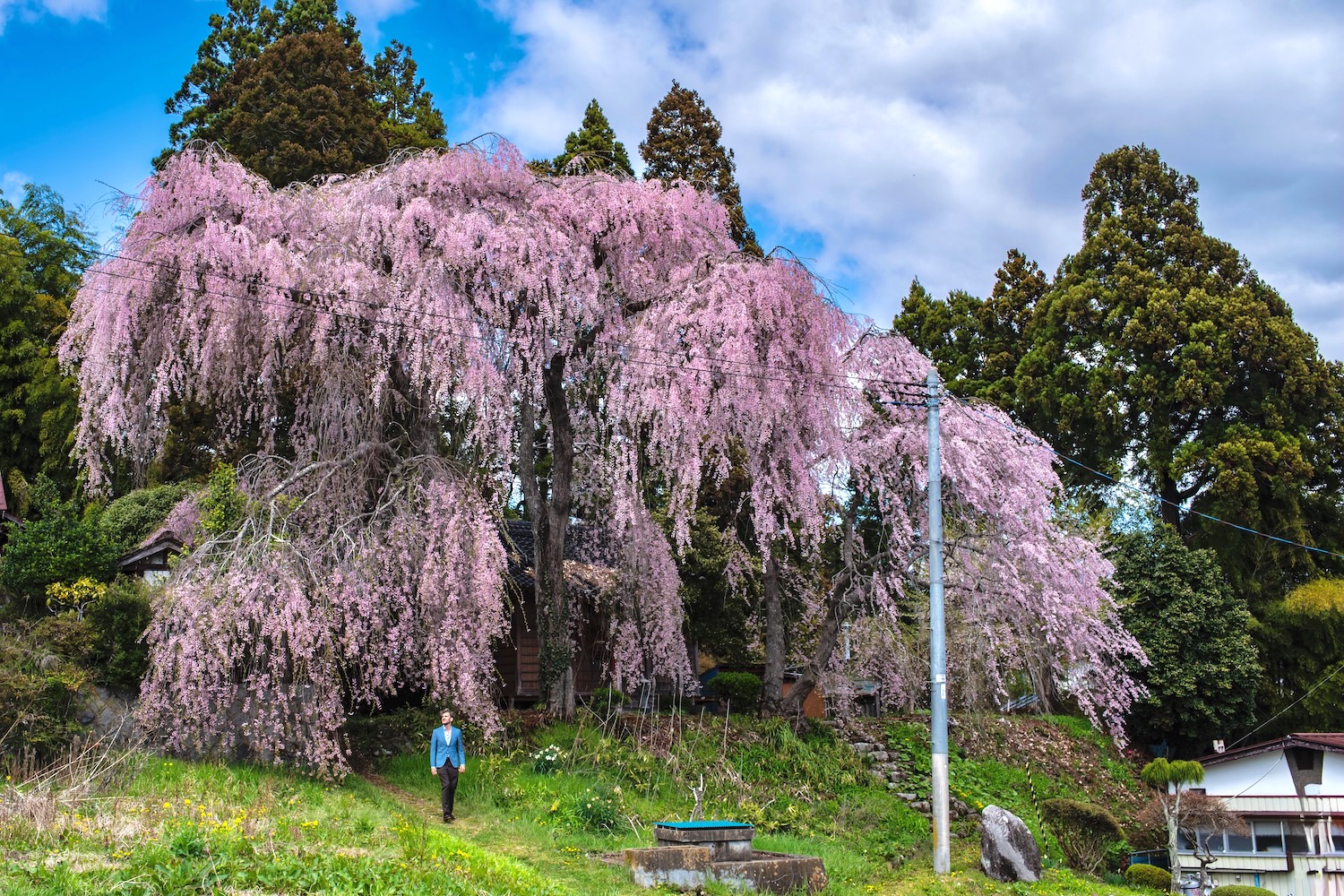
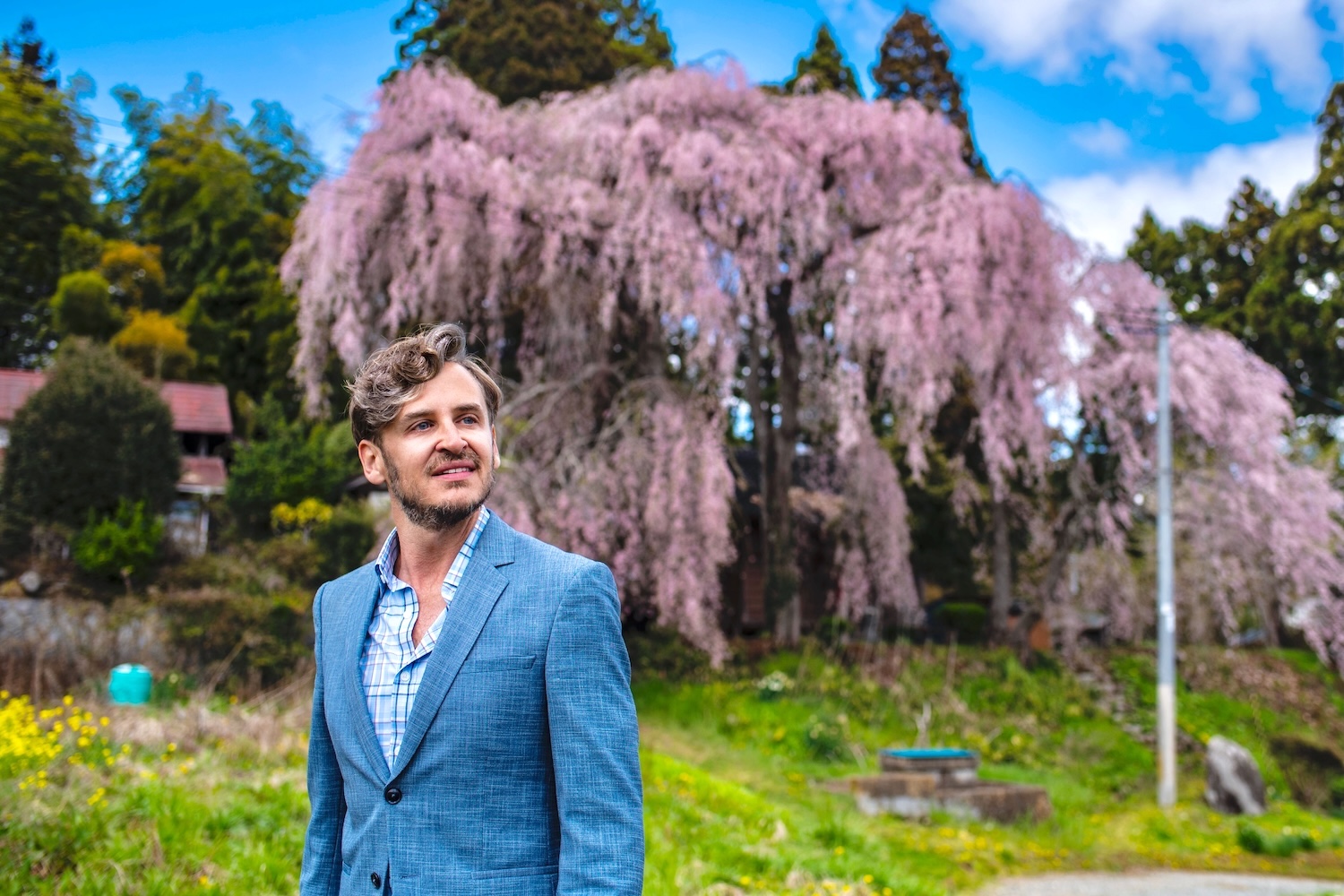
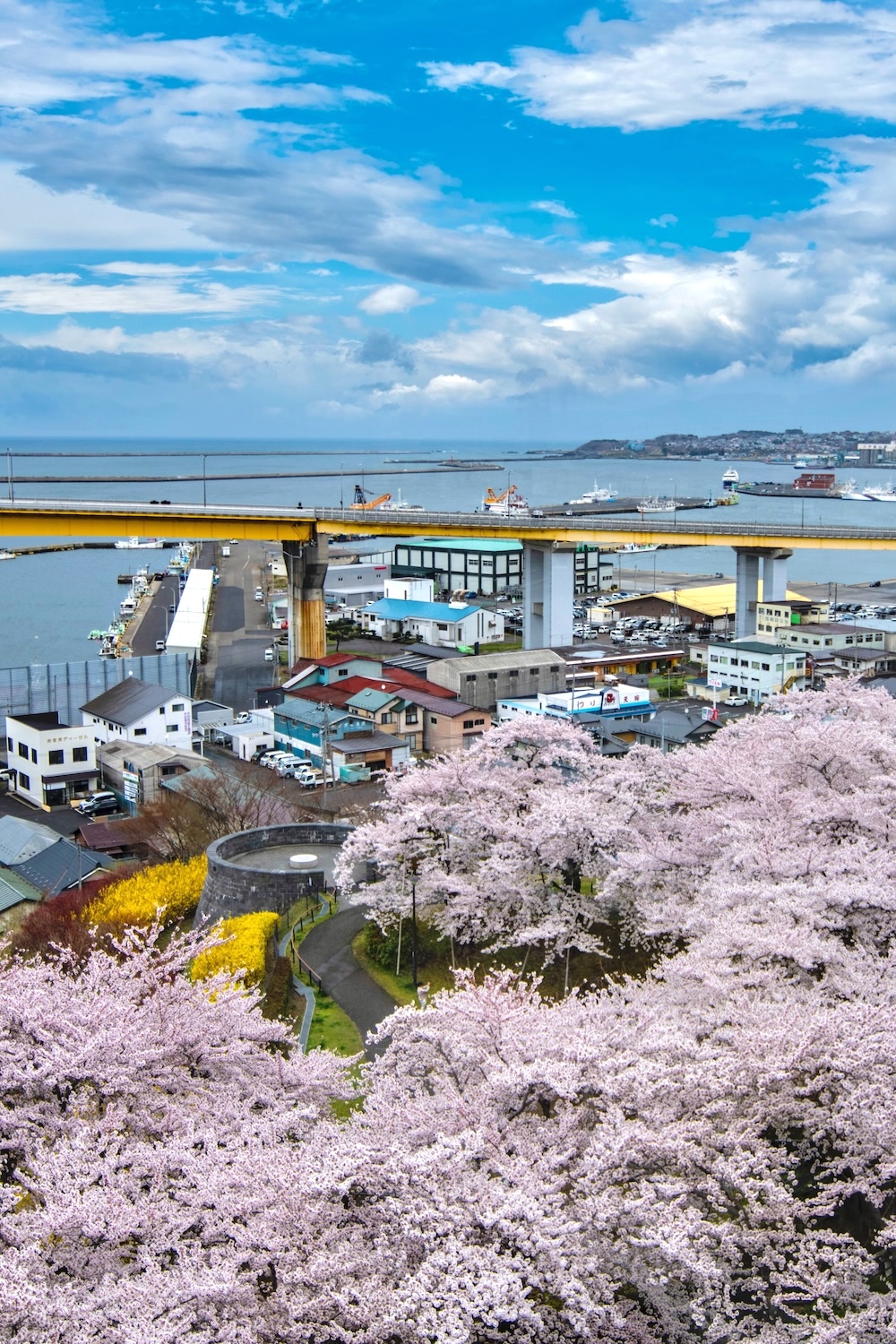
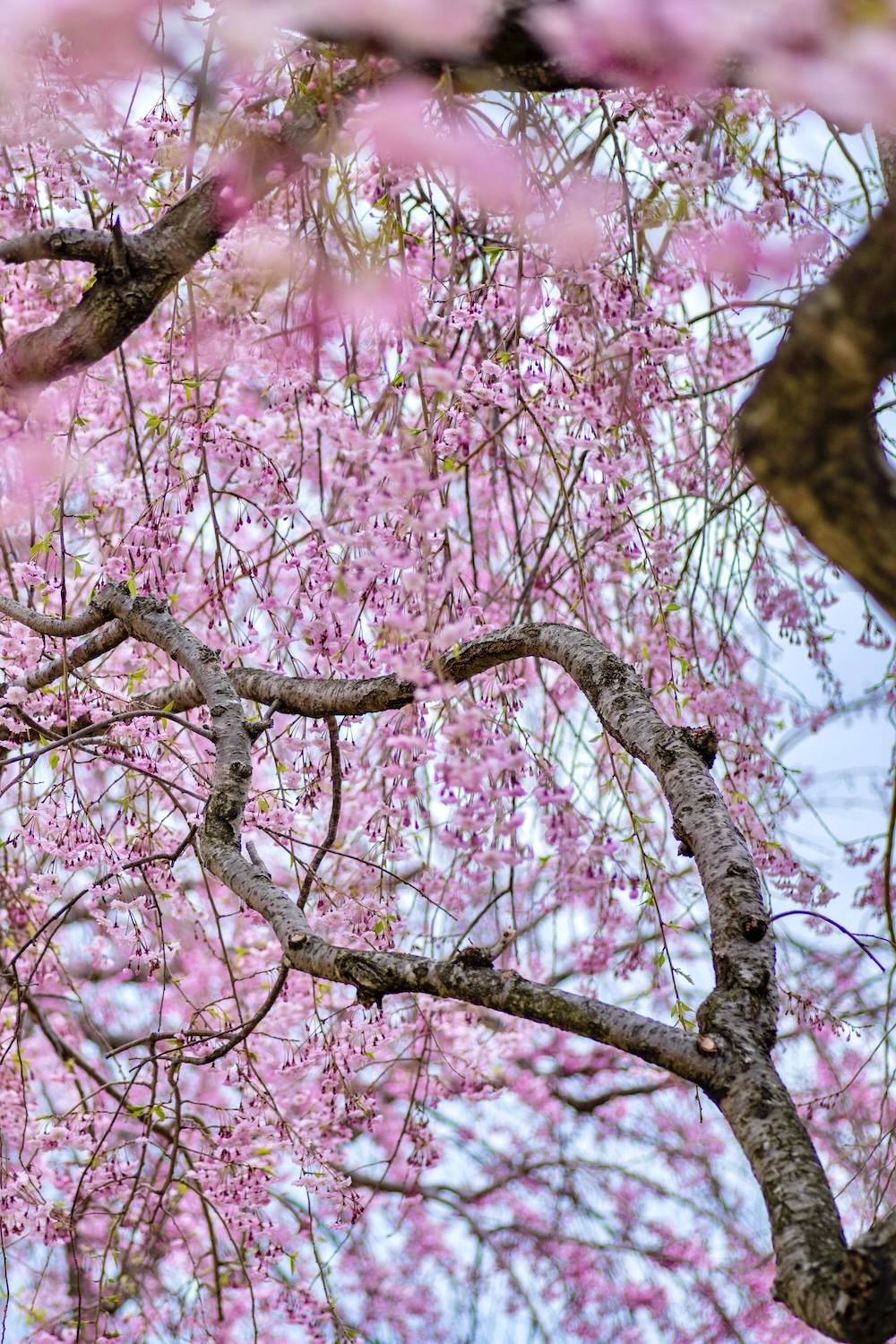
The towering shidarezakura came out of nowhere. Or at least that’s how it felt laying eyes upon it as I white-knuckled along the tiny, twisty roads leading to it from the center of Kesennuma, a Japanese city I’m betting you’ve never heard of.
(I had, to my credit, though this was my first time setting foot there.)
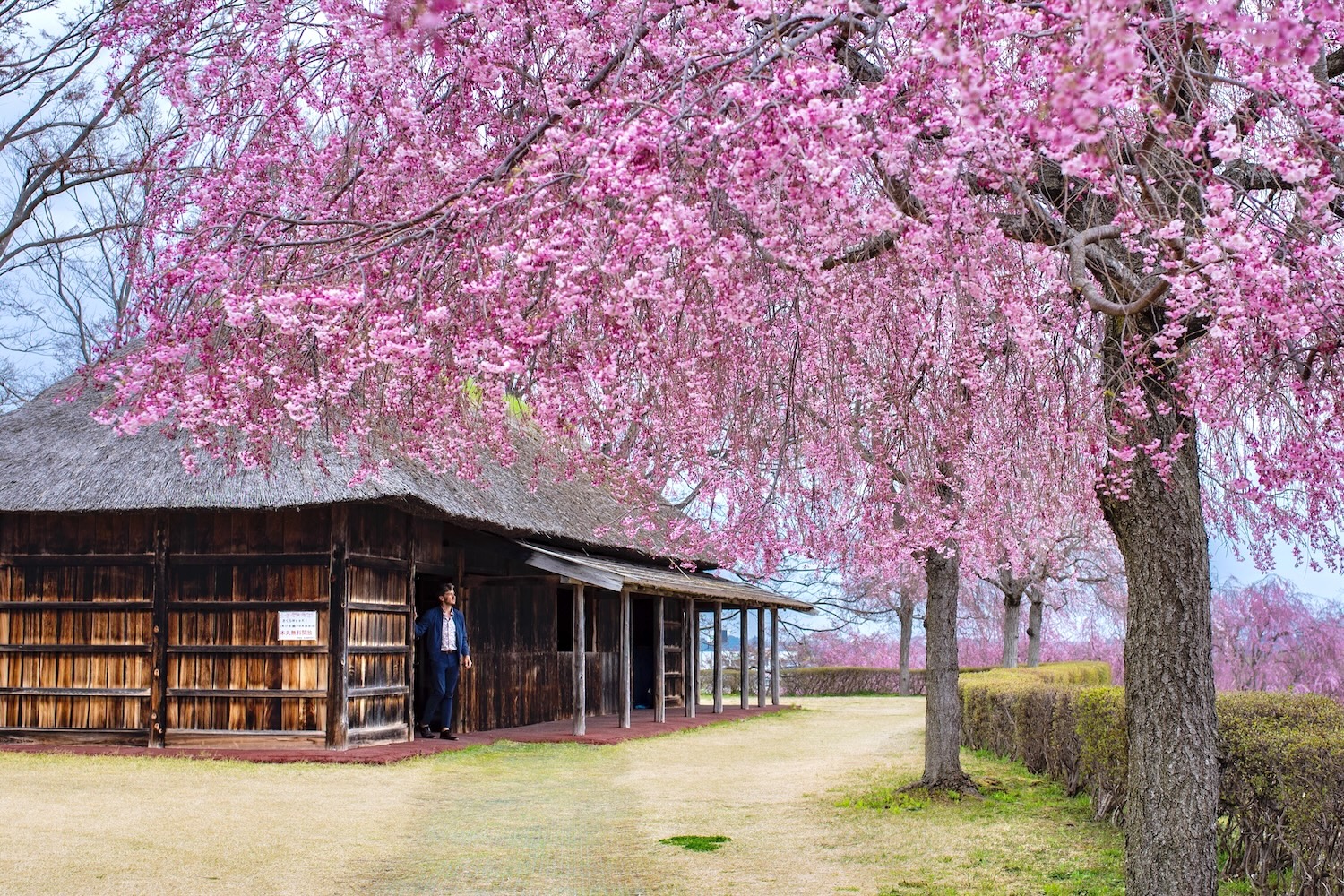
I’ll have more to say about this place—all of it positive, glowing even—but suffice it to say, it is not a tourist trap. In fact, apart from a 50-something Japanese woman (who, bless her heart, seemed just as frazzled as me the drive), I was the only person there the entire time I was photographing the “weeping” cherry tree, which almost entirely covers Denpo-ji, the temple where it lives.
The experience was pure joy, particularly as bright sunshine broke through the layer of clouds leftover from the previous day’s gloom, cracking it open like the top of a crème brûlée when you tap it with a spoon.
And it stood in stark contrast to the previous day which, due to factors both predictable and those far outside my control, saw me cynical and despondent for most of it, a soup of dysregulation worsened disproportionately by how jet-lagged I still was.
Having finished taking all the photos I needed, I grabbed my bag and hurried back to my car, but then thought better of it: This was a moment I needed to savor.
Just then, a schoolboy walked by, though I was unsure why: It was just after lunchtime; I doubt children that young (he looked no older than 10) can leave school so early in Japan.
Initially, I felt like I was witnessing something profound: This child almost certainly hadn’t been born when the tsunami, which hit Kesennuma especially hard, came ashore a decade-and-a-half ago.
And yet, as I turned my attention back to the tree (which had no doubt survived the tragedy by virtue of being so high up on its hill), I realized the kid’s presence was utterly mundane. New people are always born after old ones die, even those who perish under apocalyptic circumstances. These kids are none the wiser; many older folks forget the event entirely after a time.
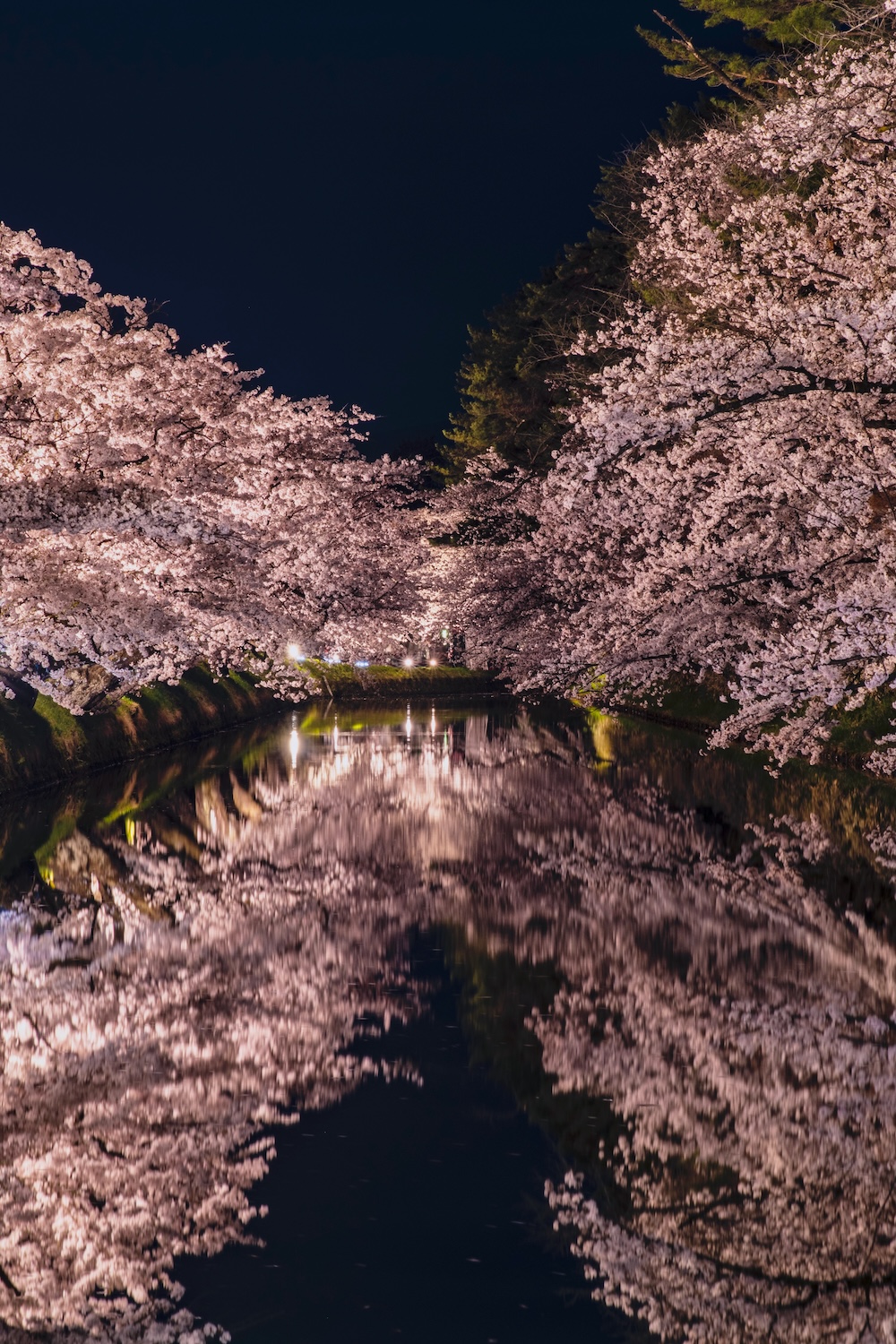
“Doko ni kimashitaka?” The woman asked me as I began packing up my tripod, having spent the previous hour photographing Hirosaki Castle’s sakura-lined moat as it illuminated.
Which is to say my brain had atrophied. “Hai!” I answered, legitimately not having understood the question.
She repeated it.
I laughed, and then answered as if I was in the first day of Japanese class. “A-me-ri-ka kara kimashita.”
It was invalidating when she immediately pivoted to English upon hearing me speak, but it made things easier in the end.
The woman, who told me that she hailed from Kamakura, had rented a van in order to follow the entire cherry blossom front—plans which, like mine, had been heavily complicated by how historically early this year’s bloom was.
She explained to me how she had planned to stay on the road until Golden Week, when Hakodate and Sapporo usually reach full bloom, but would likely head back after Hirosaki’s famous “petal moat” began to form.
“When do you think that might be?” She asked, restoring my sense of legitimacy in an instant.
Cherry blossoms, to be sure, are an area where I don’t mind tooting my own horn. And ironically, one where the mistakes I’ve made chasing them over the past decade-plus have deepened my expertise—my mistakes this year, too.
Post-covid, you see, I’ve taken an every-other-year approach to sakura: The odd ones are all-in trips, where I follow the forecast obsessively and fully plan and book out two (even three) versions of the trip, canceling pieces and adding new ones as new information becomes available, an experience that leaves me both energized and exhausted at the end of it.
In even years, like this one, the blossoms are a nice-to-have, not a need-to-have. Or at least that’s what I told myself; in 2024, the last such trip before this one, it was due to dumb luck (a late bloom, especially compared to recent years) that I saw as many as I did.
The opposite, of course, was true this year; had I not quickly pivoted my strategy (in this case, shifting northward from Fukushima and Miyagi to Akita and Aomori), I might not have seen many trees in mankai at all.
The two of us walked for a moment, allowing other photographers to take our prime spots. Upon learning that I had already been in Morioka City, in the Kakunodate Samurai district and at Lake Tazawa that day alone, she seemed surprised that I’d fluttered to and fro so nimbly.
Whereas I, after hearing that she would be camped out in Hirosaki at least through the weekend, felt shocked by how anchored she’d been in such a restless sea.
We exchanged Instagram details and I bade her farewell and I stood there for a moment, savoring its sweetness. Ironically, given my previous linguistic stumbling, I did spend a moment thinking whether there might be a Japanese word or phrase to describe the wistful melancholy of a single moment of real connection.
But then I realized it didn’t need a word: The cycle of the sakura themselves was the perfect metaphor for the elusive feeling passing through me, not unlike the way each year’s bloom passed northward and eastward across Japan like a tidal wave of petals and pollen.
I did briefly return to the same spot the next morning; it was uncrowded for the same reason (rain) that I ended up not staying there for long. I instead set my GPS for Hachinohe, a city on the opposite side of Aomori prefecture, one that has outsized importance in my travel biography.
Hachinohe, you see, was the first city I visited when Japan reopened in September 2022, having ended nearly three years of what I derided at the time as its second Sakoku period.
Back then, I’d been so excited simply to be back in the country; if I’m honest, I probably didn’t do Hachinohe (which, to be fair, has never been and will likely never be a top-tier tourism city) justice.
I did however plant some seeds, among them a promise to myself that I would return to Nejō (a “castle” so completed ruined that it barely lives up to ever having been one) during cherry blossom season. The brochure I’d received upon paying the site’s nominal entry fee depicted literally hundreds of shidarezakura, which I could only imagine amid the dull green of September.
Now as then, I spent a long time walking around its acres, acres I didn’t remember all that well, considering that less than four years had passed since I was there previously. Cherry blossoms are disorienting.
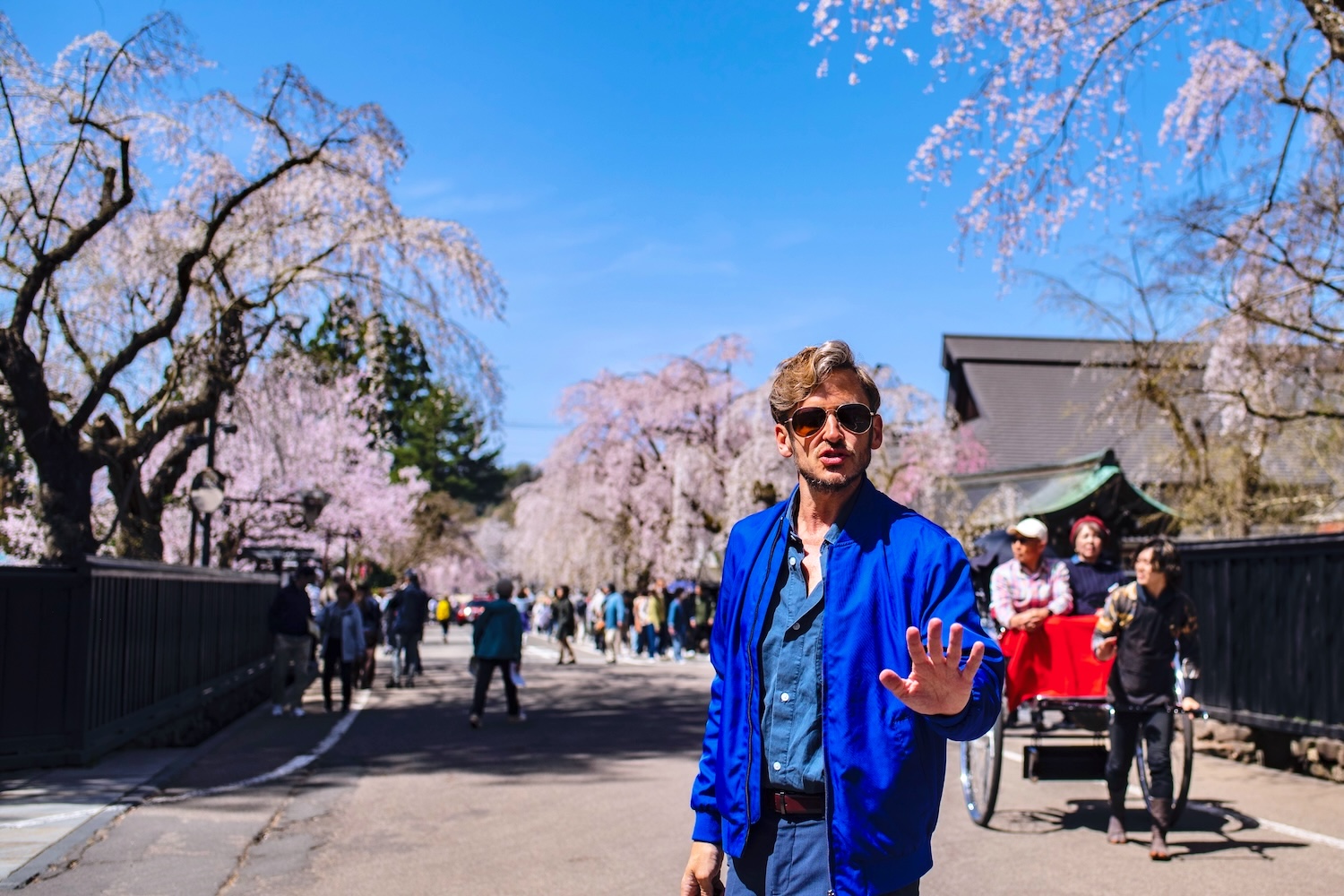
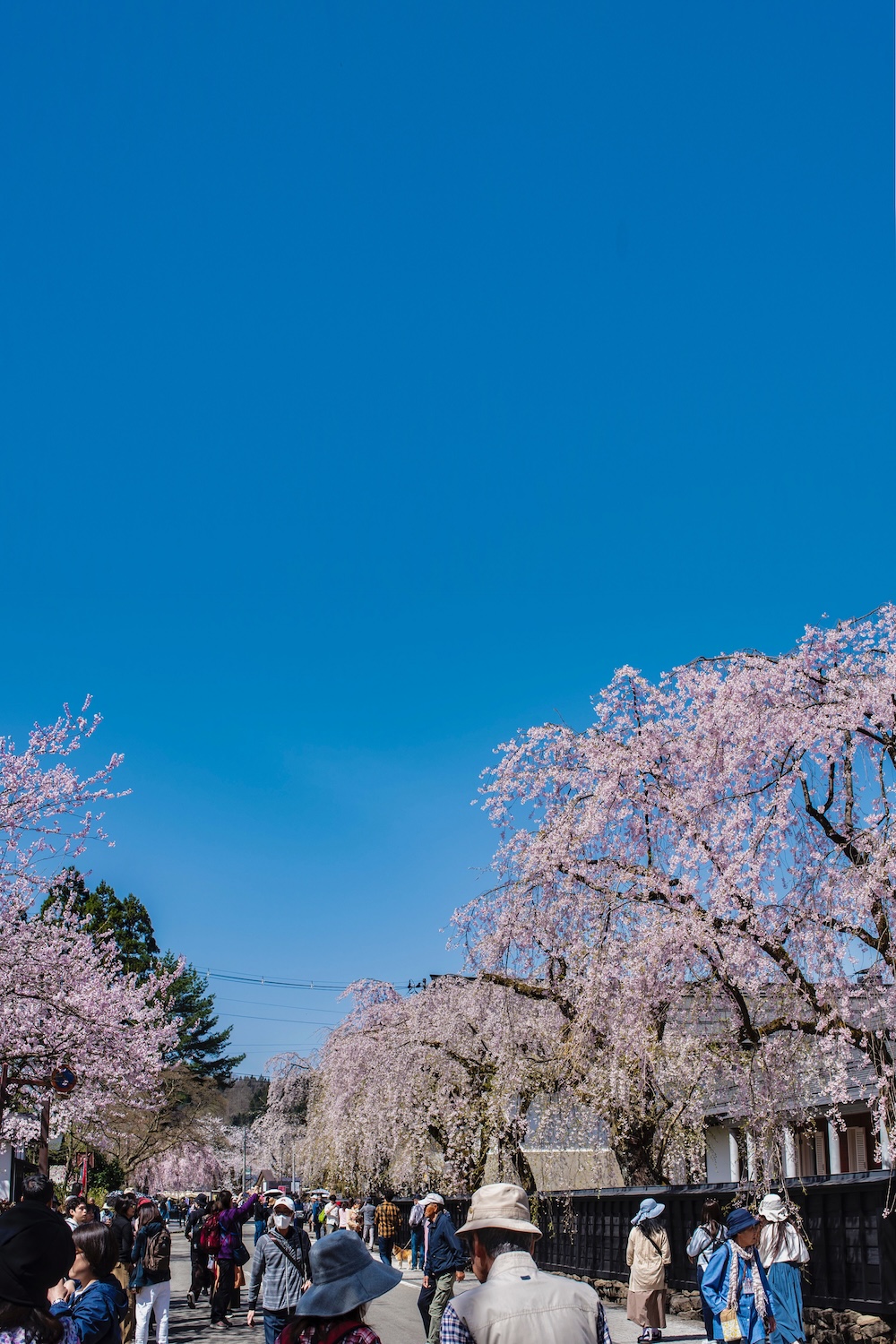
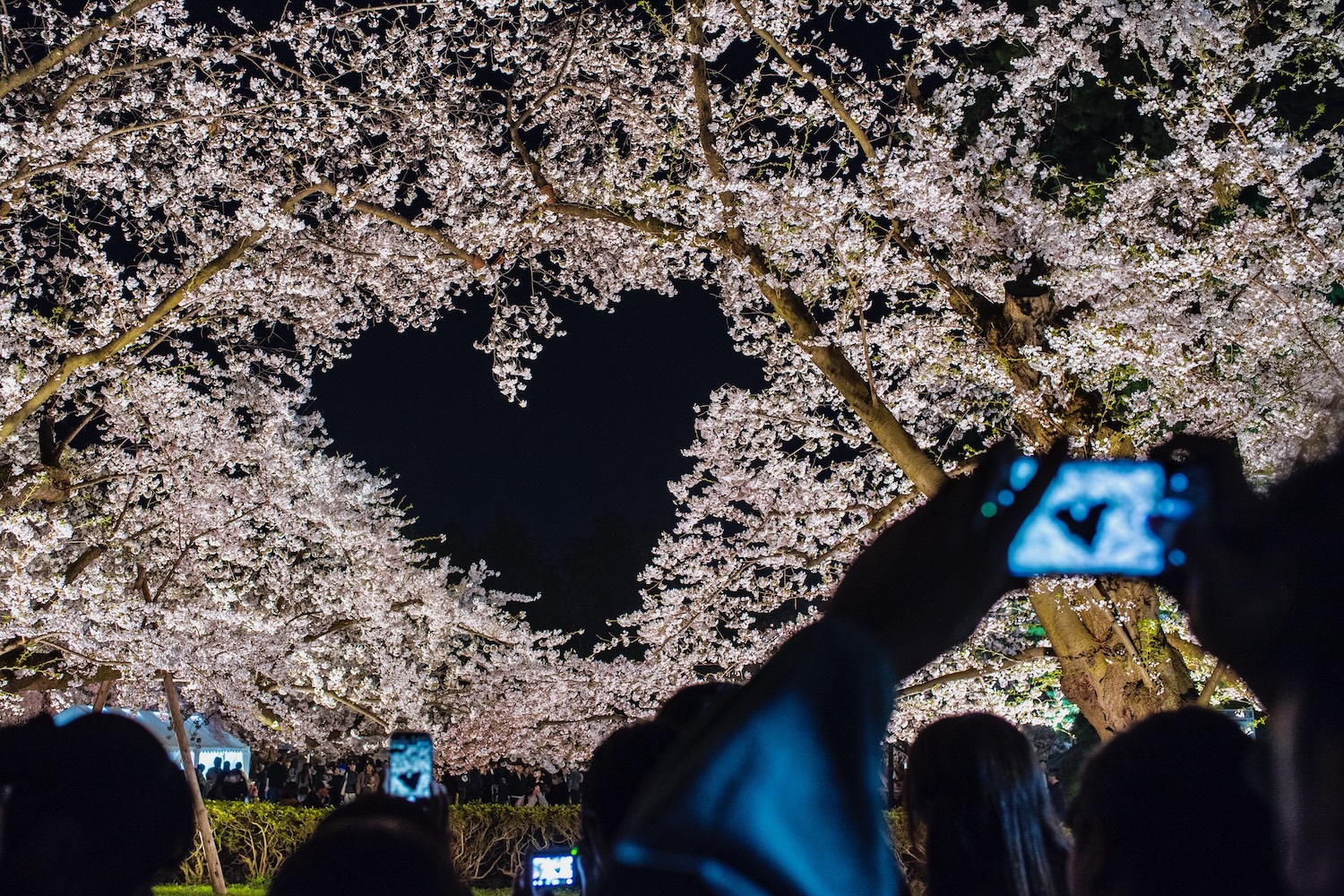
As my Shinkansen sped away from Morioka Station the next morning, I noticed a long—seemingly endless—line of cherry trees along the main east-west boulevard south of town. They were shaped like (or, more accurate, had been pruned into) hearts.
My own heart was soft after so many days in sakura-blessed Tohoku; I interpreted my having noticed the trees as a message from the universe. Aw, I thought, taking a sip of my Red Bull Sugarfree as they disappeared from sight. They’re saying goodbye to me.
Unfortunately, arriving six hours (and two more trains, plus a bus) later at the entrance to the town of Magome in the Japanese Alps, I had a more cynical interpretation.
They were begging me “please, don’t go!”, I sighed as I rolled my eyes and walked past a 60-something Frenchman, who’d had the temerity to ask me if I could take a picture for him and his family as I huffed and puffed up the hill with all my luggage on my person.
Now, if you read this blog with any regularity, you’ll know that I’m not generally a believer in the concept of “overtourism.” I find it classist, racist and reeking of entitlement; in the specific context of Japan, the issue is not as much the number of tourists as it is the places where they’re disbursed.
Still, the scene in Magome (and, after dropping my bags off, en route along the Nakasendo to Tsumago-juku) was shocking. The first time I came here (albeit 11 autumns ago, before Japan’s ongoing tourism boom began in earnest), I was one of only a few people on the trail. Today there were hundreds, maybe thousands, almost all of them foreigners.
It wasn’t all bad, of course. About an hour out of Magome, after passing through the first major downhill section and through a pine forest filled with oji, I happened upon a trio of shidarezakura in full bloom, a spectacle that made a single house (whose ground floor had admittedly been converted into a drink kiosk) seem like a full-blown village.
Likewise, I finally paid a visit to the Odaki and Medaki Waterfalls—which, for reasons I now fail to remember, I skipped back in 2015. Truly stupid move on my part; they’re literally a five-minute diversion from the main trail, and they would’ve been spectacular in fall.
I wish I could tell you that these moments of elation won out over the cynicism I felt upon arriving earlier that morning and being asked, with a straight face, if I might photograph a stranger while ascending a steep incline with half my body weight in belongings hanging off me like a Himalayan donkey.
But no: Tsumago felt even more like an Alpine Disneyland than Magome had, with so many travelers clogging its main road that I could hardly get a picture of anything. Which again, is fine—I’m no more deserving than anyone else—but shocking; the last time I looked upon this place with my own eyes, it was literally deserted.
A particular bee in my bonnet (perhaps a strange metaphor, given the large population of so-called “murder hornets” that reside along the Naka-sen-dō, which was once an essential postal route linking Kyoto and Tokyo) came in the form of a boomer Kiwi couple, who emerged from a souvenir shop right as I had set up tripod up for some self-portraiture.
It wasn’t the fact that they were there that bothered me; I didn’t even necessarily expect them to move. It was the fact that they continued standing there, recording a TikTok describing their handicraft haul in way too much detail and without moving, for literally 10 minutes.
The woman was simply obnoxious; the man, however, was aggressive, literally staring into my camera as I attempted to do my work without compelling them to get out of the way.
Worse, it turns out that they (and their son, who’d earlier been nowhere to be found) were staying in my guesthouse back in Magome, and were even on my bus to Nakatsugawa the next morning. They didn’t say a single word to me in all the times we found ourselves in the same place, though their disdain (especially the man’s) was plain to see. The kid seemed silent and withdrawn—no wonder.
Thankfully, I learned via eavesdropping that they would be headed back to Nagoya (which, of course, they pronounced Na-GOY-a), rather than onward to Kiso-Fukushima like me.
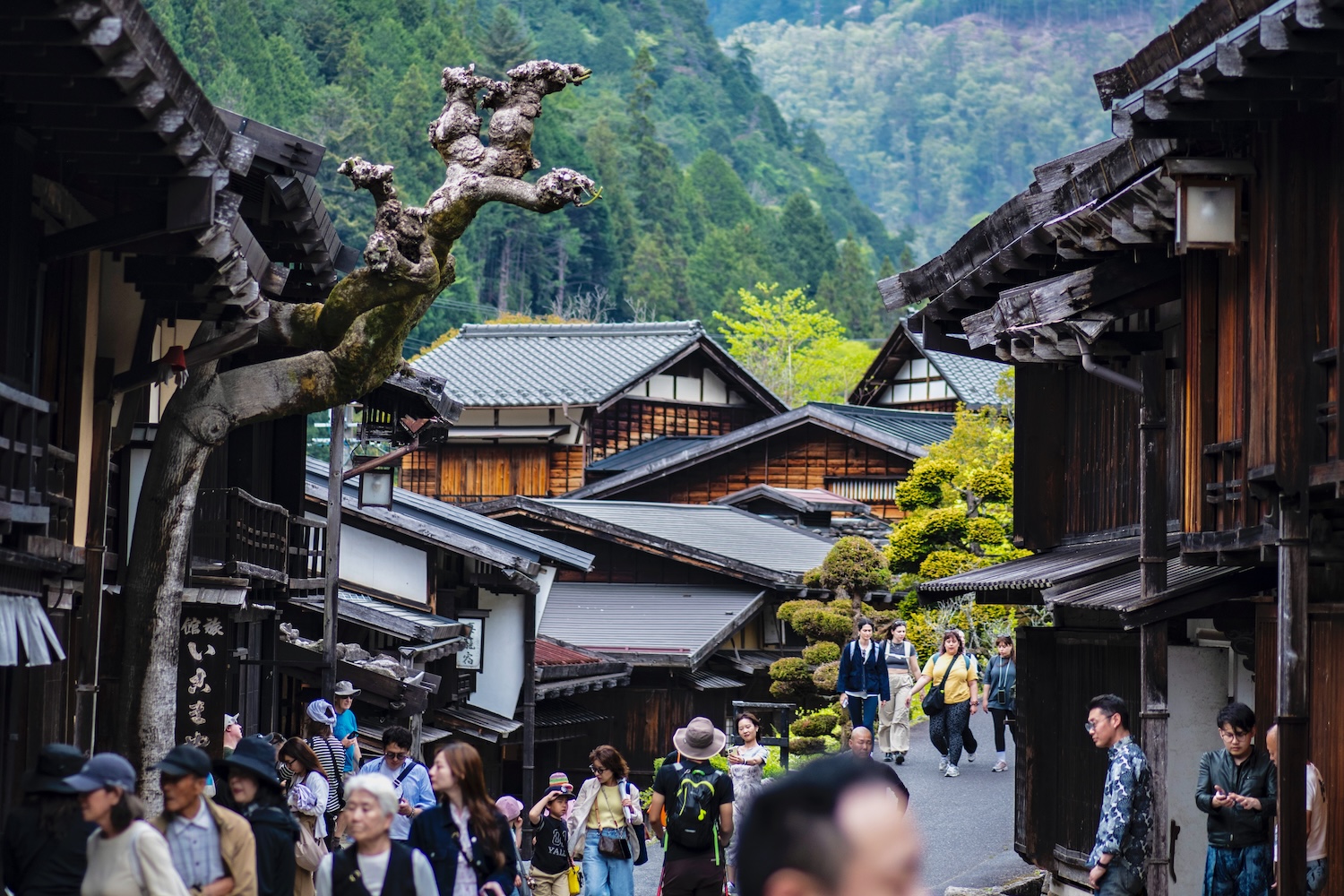
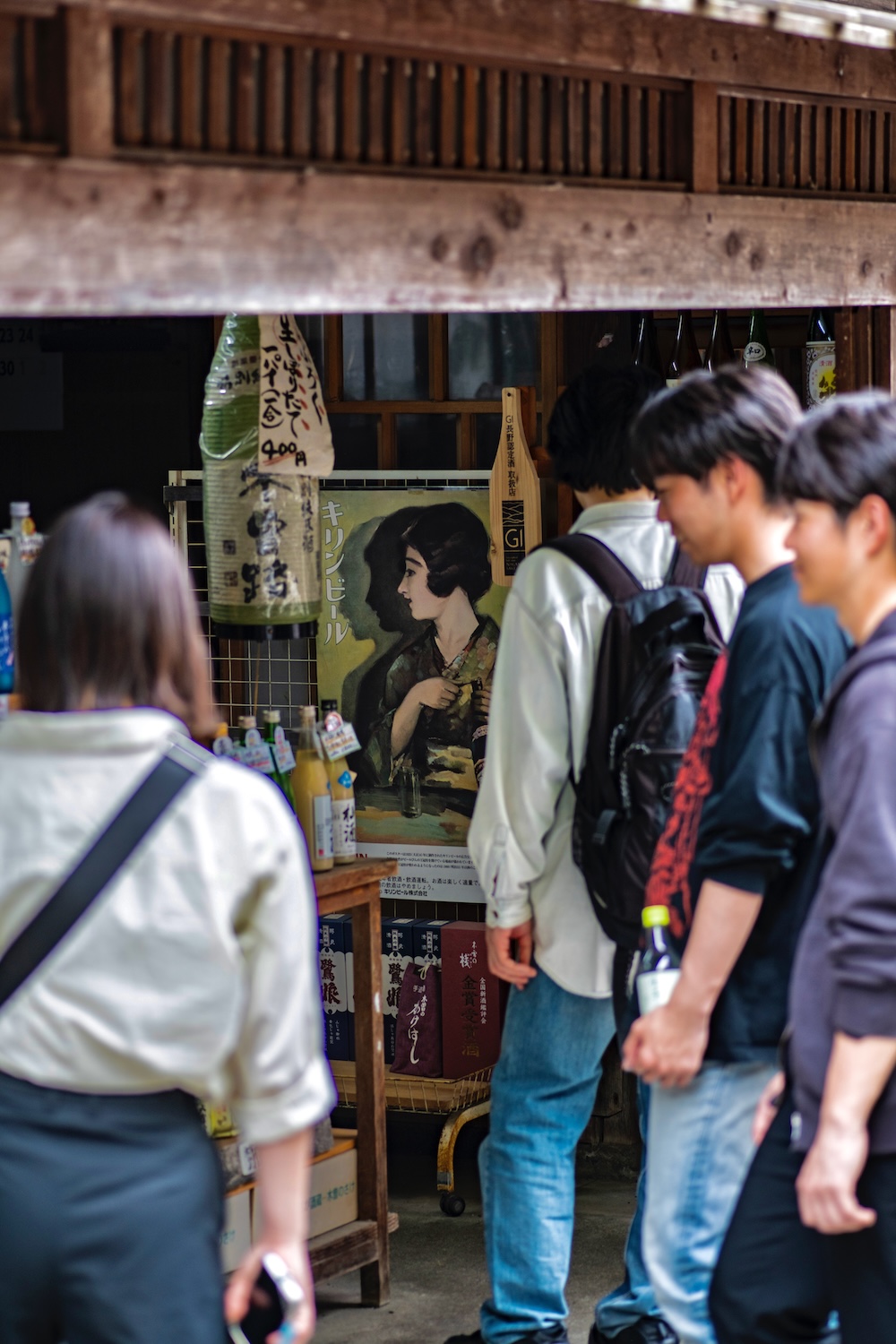
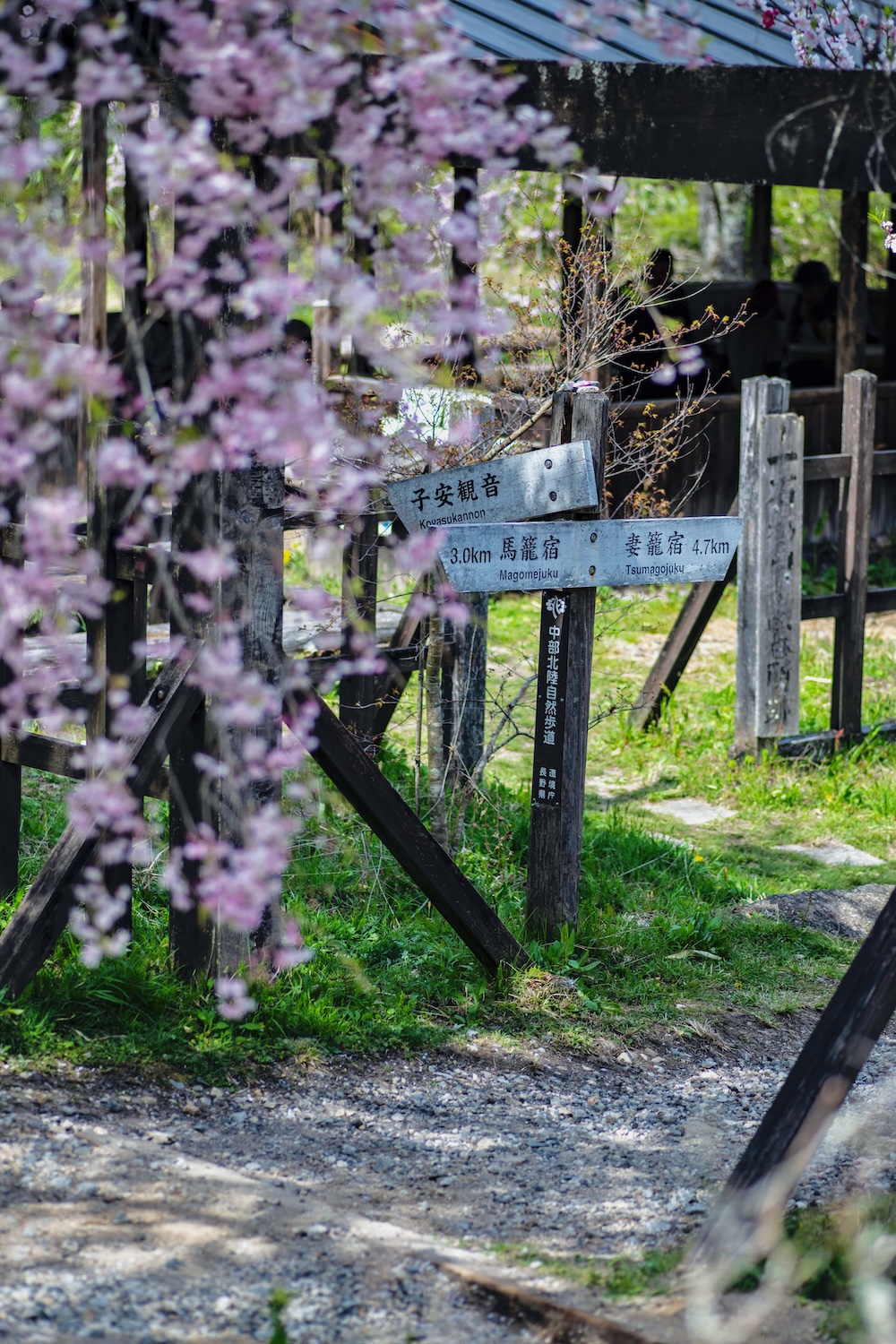
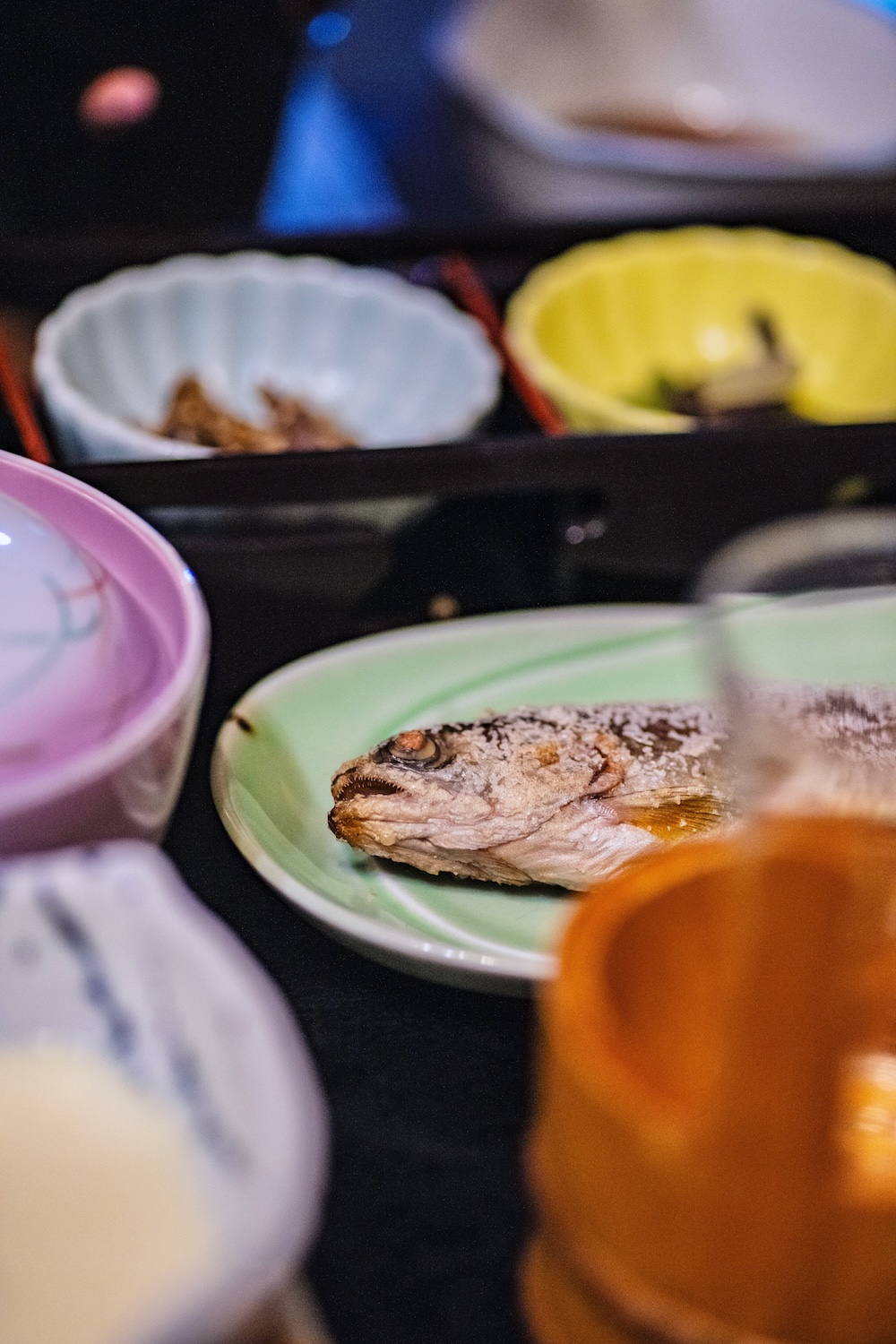
I’m delighted to report that both here, as well as along the Torii Pass from the subsequent town of Yabuhara to Narai-juku, the final stop along the trail, there were significantly fewer tourists. Almost zero in fact, just as had been the case in 2015.
Well, not completely delighted. It is very often that you may encounter bears, read the sign at the entrance to the tōge, with a perfunctory bell it suggested all visitors ring before entering.
There was a colored piece of tape with the word “NOT” written on it, placed between “is” and “very”; although the Japanese version of the sign confirmed that this statement should’ve been negative, I wasn’t comforted.
I did encounter a few travelers along the way. First was an older couple from Taiwan (the man told me “You have a big engine!” as I sped past him and his struggling wife—if he’d been alone I might have thought he was hitting on me.
Then, there was a group of hikers from Singapore, who seemed genuinely impressed when I told them, nearly to the summit, that I hadn’t stopped once since getting off the train at Yabuhara Station.
It was only after reaching the Torii Pass itself (and the checkpoint where I had to decide if I wanted to continue back to Yabuhara or onward to Narai—I chose the latter) that things started feeling creepy. It was quiet, except for the bear bells attached to my backpack. I hadn’t needed them the day before; they felt like an insurance policy now.
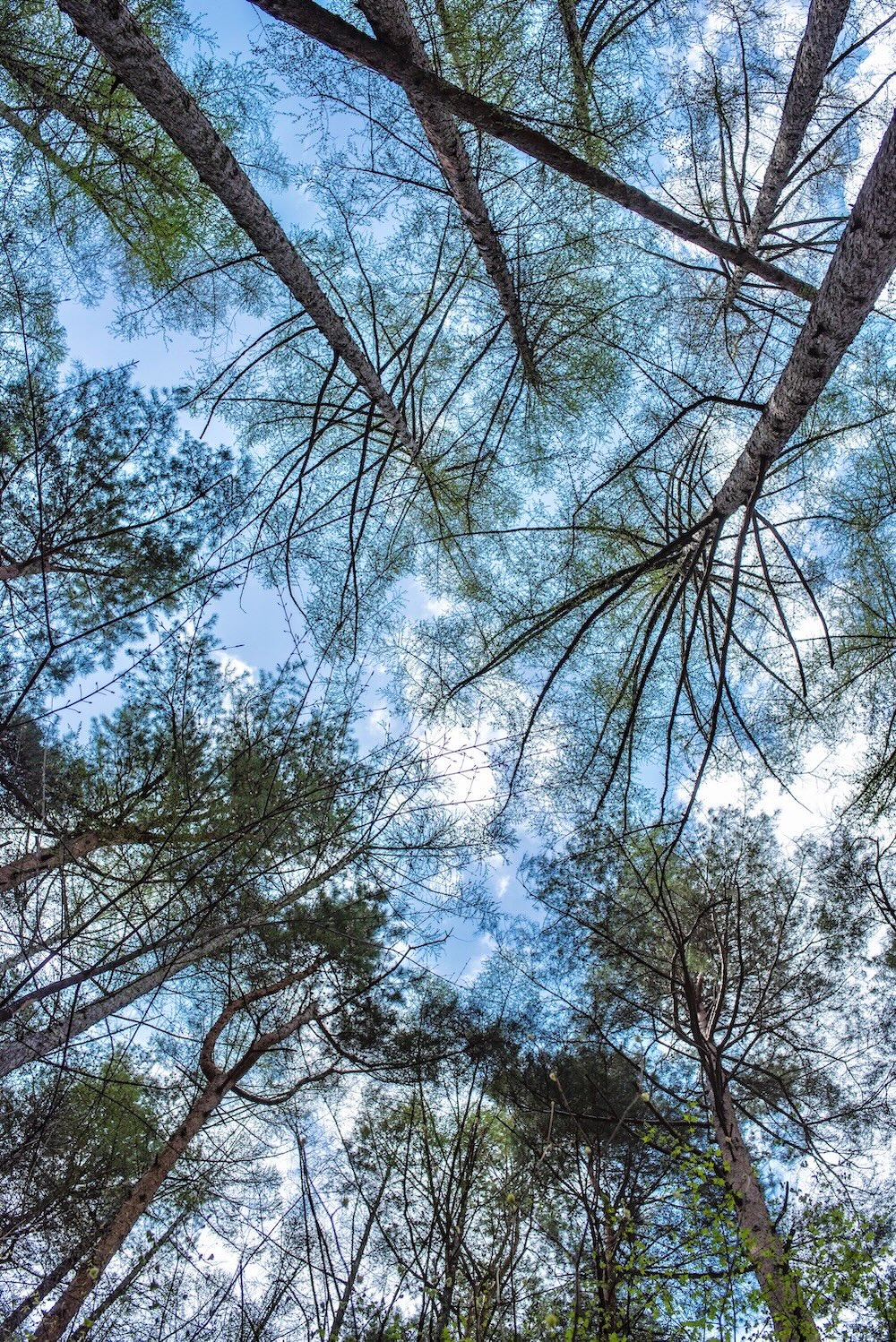
That and the wind roaring through the tops of the towering pines. It sounded like the swoosh of a Shinkansen speeding through a secondary or tertiary station.
I tried not to dwell too much on the prospect that I might be one of the lucky trail users to encounter a bear, even when I heard rustling in the woods beneath me that I’m almost sure was a kuma. I comforted myself when I could, whether it was because I could literally see the highway just below, or when I noticed a pair of frogs mating in a puddle. Surely, they’d be an easier meal.
I ended up finishing my journey a full 90 minutes earlier than I anticipated; I felt elated as I arrived at Narai Station in time to catch a train that left a full hour before the one I intended to take.
Just then, a notification. “Strong earthquake strikes off Iwate,” it said, referring to the prefecture that’s home both to Morioka and to the stretch of Sanriku where I’d just been. “Tsunami warning issued.”
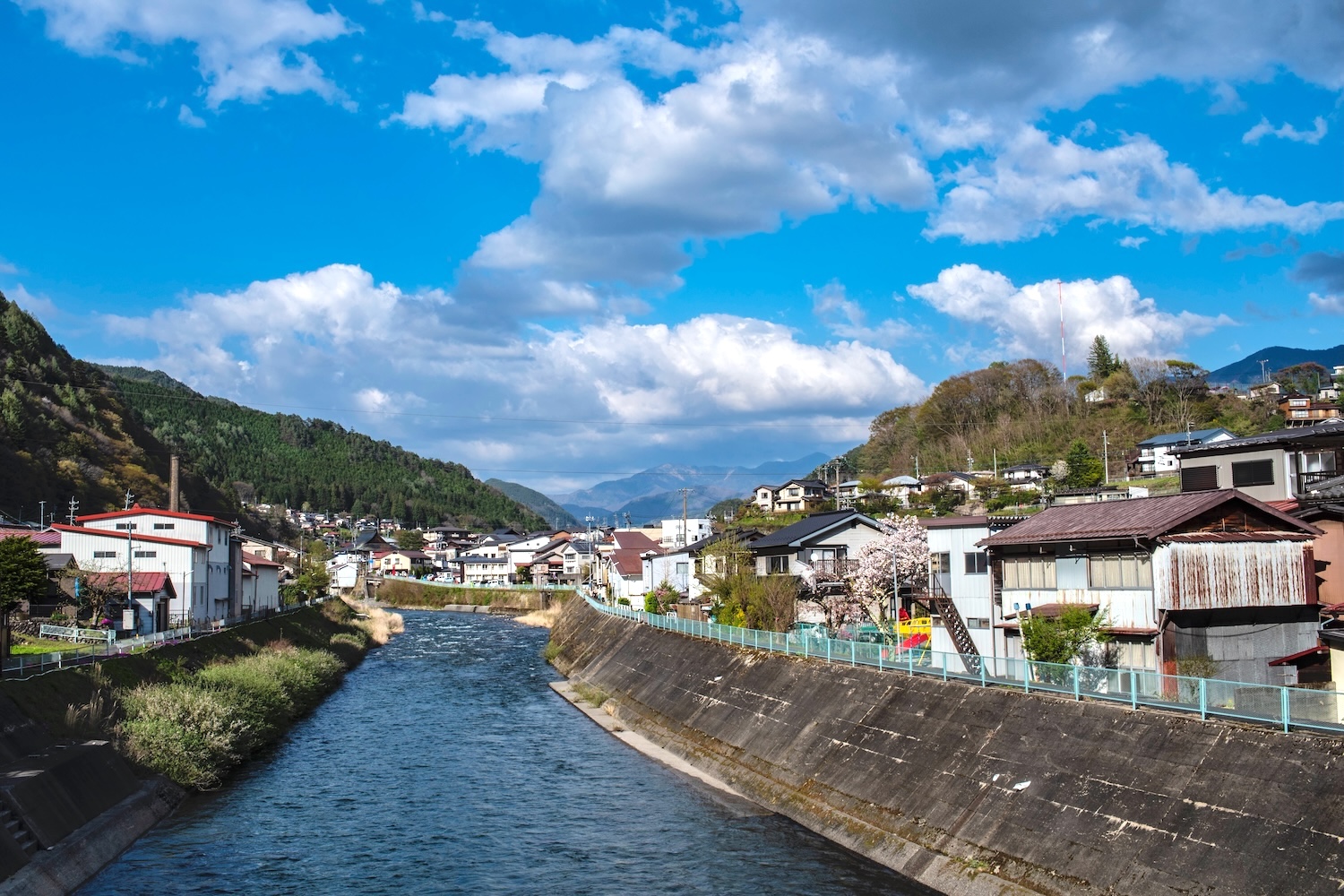
By the time you read this, you’ll know that no wave of any notoriety hit the Sanriku-kaigan in mid-April of 2026. That’s the good news.
The better news? Both of the days I got back in a rental car after my Nakasendo hike were nothing short of transcendental. The rental car is operative here.
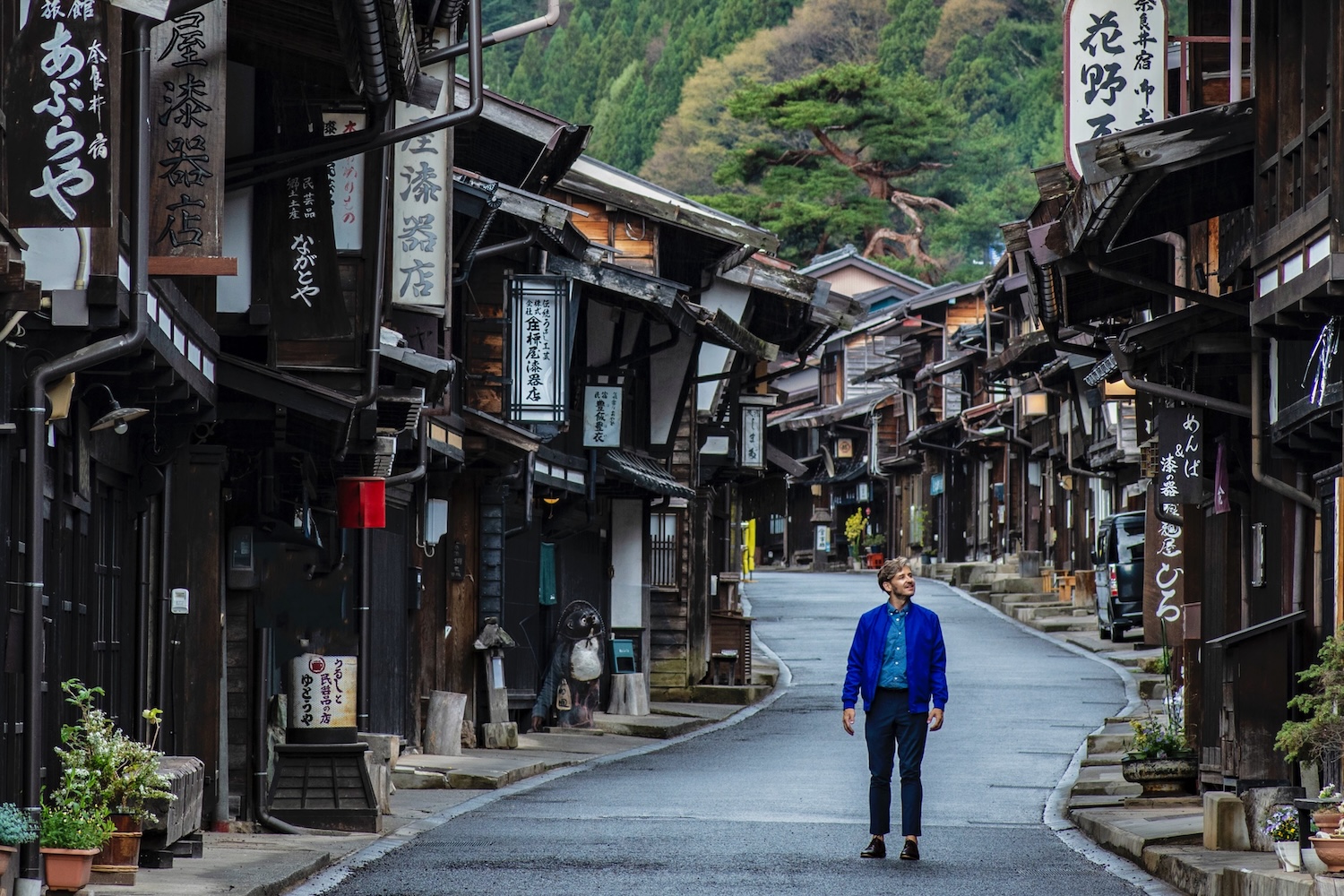
You see, on my way to Matsumoto (where I picked up the vehicle) from Kiso-Fukushima, I stopped in Narai, not having wanted to take any pictures there after finishing my hike from Yabuhara the previous afternoon. I got the captures I wanted, having been the only person there when I arrived just after 7 AM.
Well, the only tourist. There were plenty of locals, including a very friendly man who tried to chat me up in both Japanese and English as I stood outside his home scoring the money shot. I humored him a bit but, generally speaking, was the very worst type of foreigner. Dismissive. Indifferent.
I did my best to leave my guilt there; I arrived in Matsumoto with a full agenda. A too-full agenda, actually. I’m not sure if I read the Google Maps results wrong, or if I just saw what I wanted to see, but it quickly became clear that my itinerary was too stacked; I’d need to cut at least one destination out.
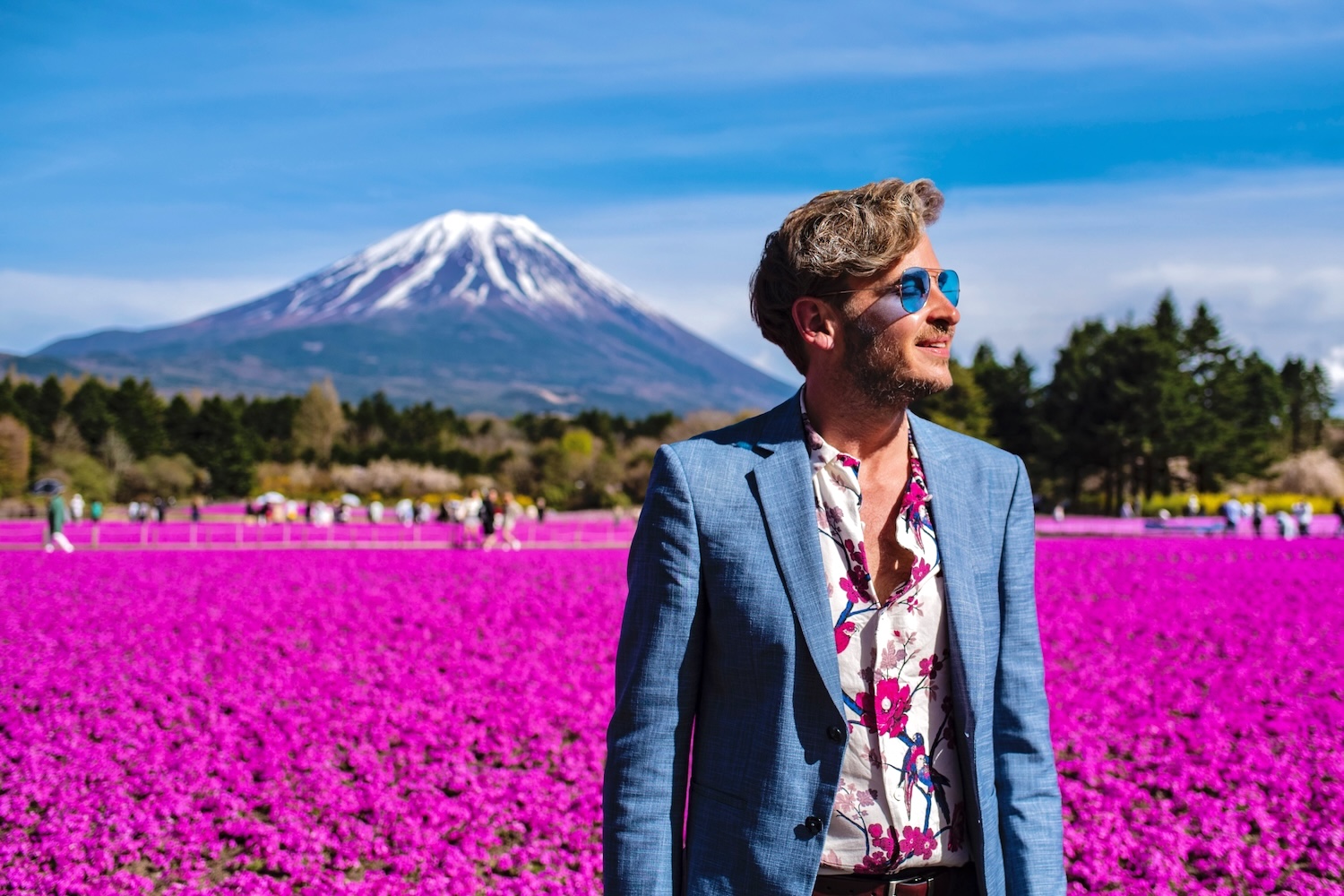
It definitely wasn’t going to be the shibazakura, a kind of hot pink phlox, which were apparently in full bloom at the Fuji Motosuku Resort near Mt. Fuji. This was the only day for the foreseeable future that the mountain would be visible; it was now or never, a word that carries extra weight in this case: I failed to see the flowers here in 2018, which now feels like an eternity ago.
I’m happy to report that they were more than worth the wait. The environment beneath Fujisan was nothing short of electric, in fact, with everyone in fantastic spirits, all of us having gotten exactly what we came for. It felt like kismet for my past self—who, incidentally, made the video announcing the launch of this website on the very day of the 2018 phlox mishap.
Even a Shiba Inu who passed me in a stroller as I literally laid on the ground to get the correct angle seemed gleeful, which says a lot: Dogs just want to pee and poop.
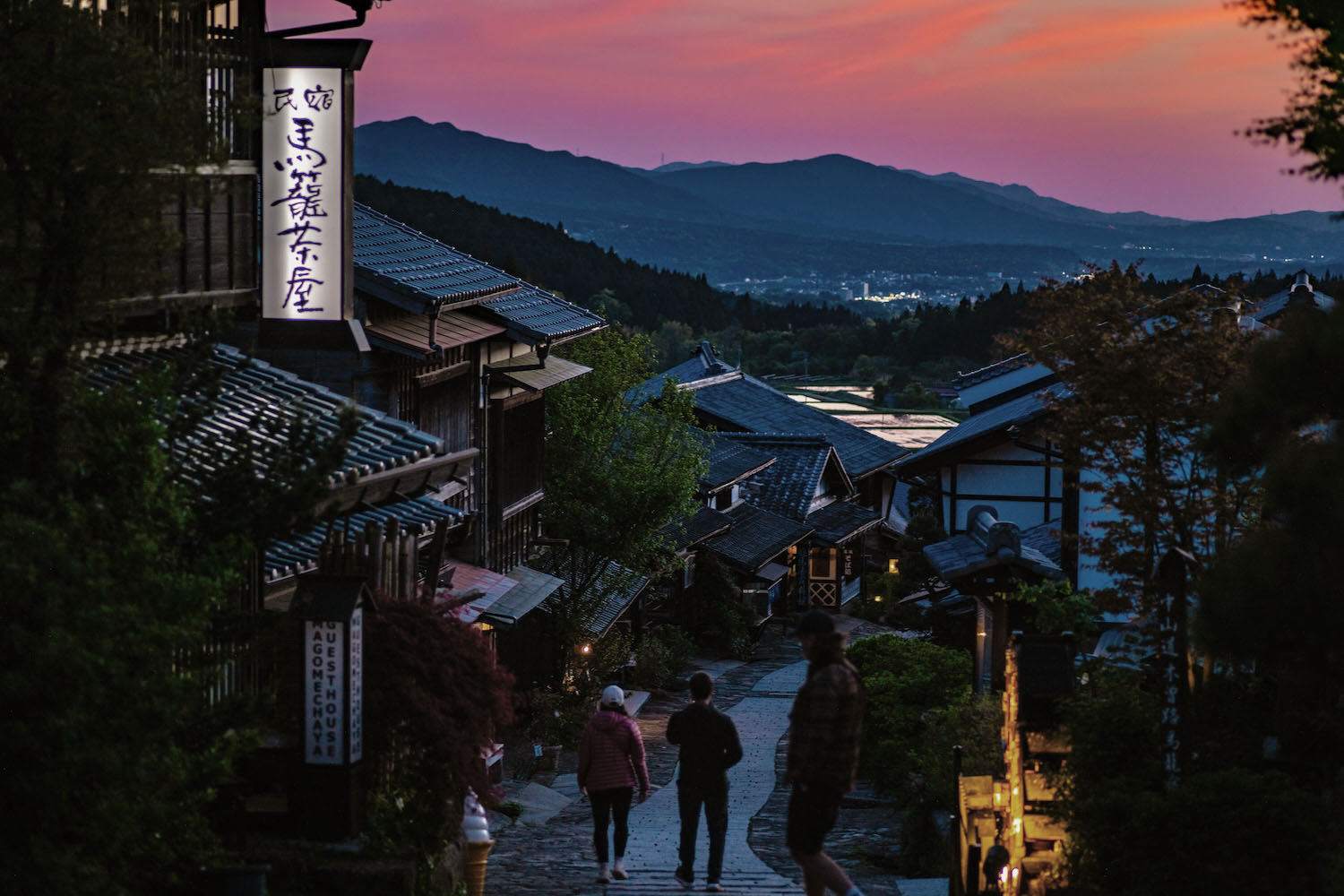
Nor could I miss sunset at Narai-juku. I’d been wanting to get a picture of this for as long as I can remember, but not a single beam of light had made it though the clouds on the night I actually spent there.
This experience ended up leaving me similarly elated, even if it was slightly awkward standing in front of the minshuku where I stayed, as both guests and staff shuffled between the inn and the restaurant across the street.
I had a feeling, based on the cloud patterns, that the colors would be vibrant, though I didn’t anticipate a salmon that fluoresced into coral and then into a color that evoked the flowers I’d just seen beneath Mt. Fuji.
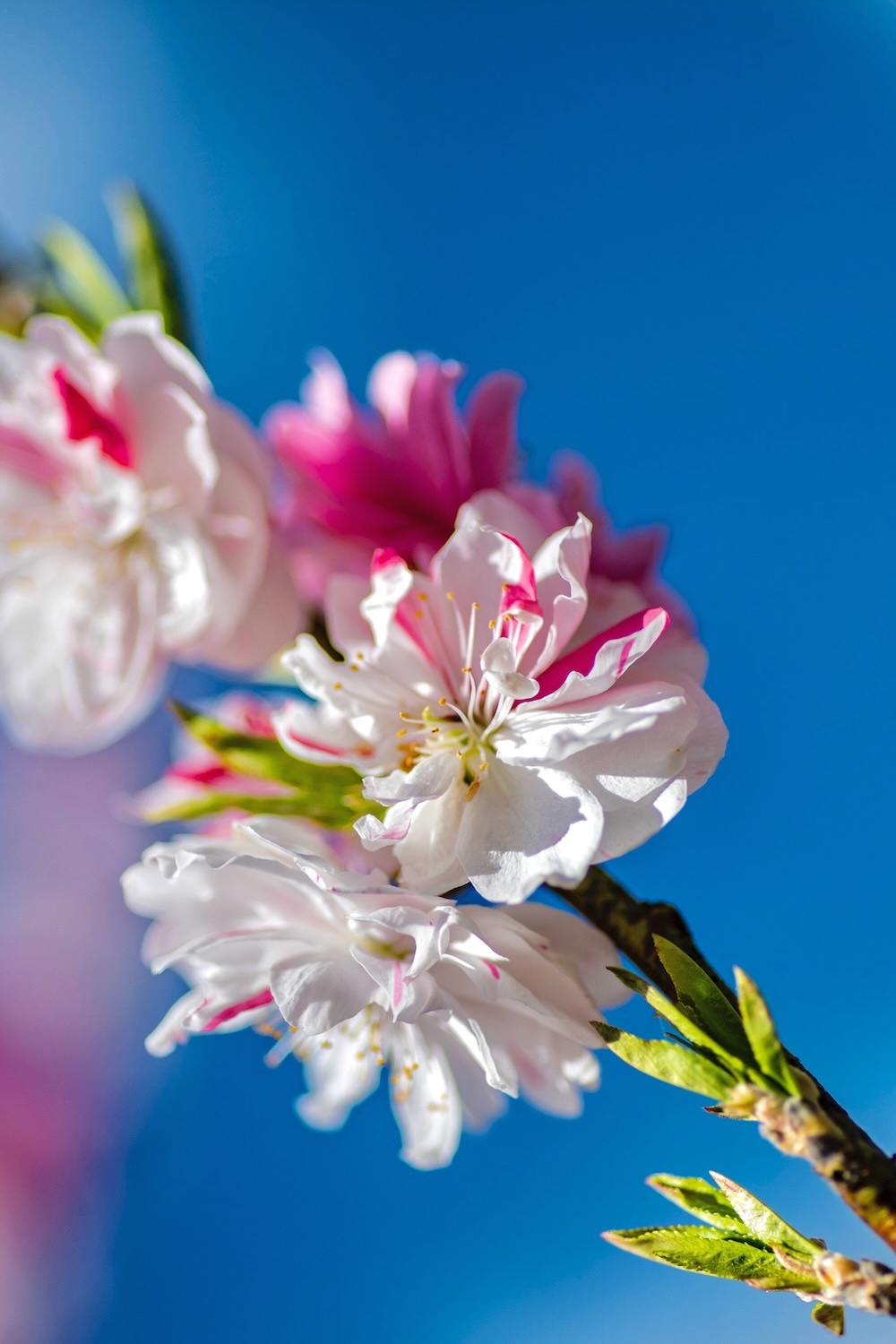
That left the Hanamomo Kaido—which, as its name will suggest to you if you know Japanese, is a boulevard lined with peach trees. Trees I knew, on account of having spent several days in this region previously, would be in full bloom.
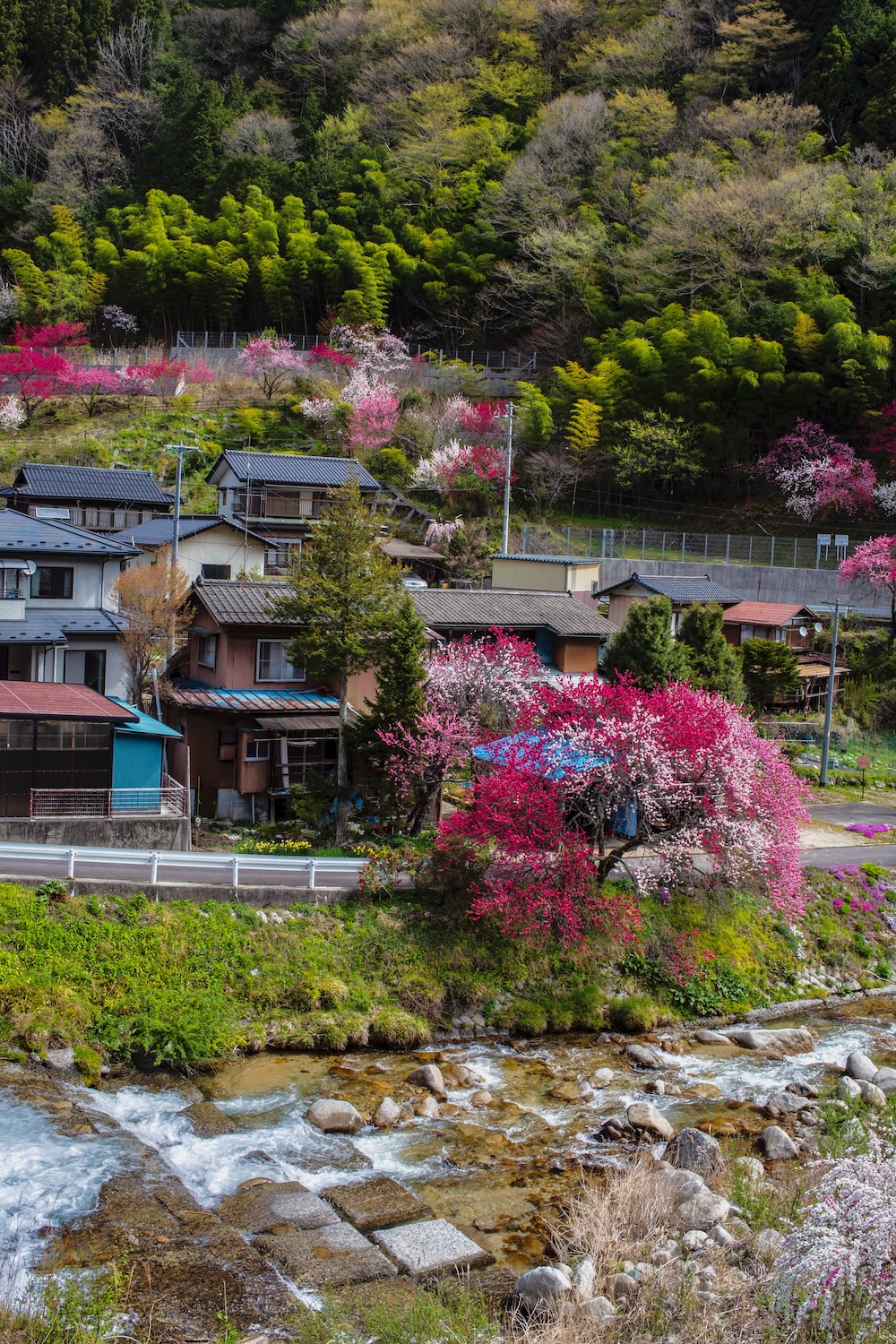
What I didn’t know, as I set off the next morning for the Peach Road, is that the main site would enter best-in-Japan territory for me—it was nothing short of paradisiacal. A crystal-clear stream flowed through the small town, which was really just a farm and half a dozen houses; there were more momo-no-ki than hito.
And then there was Junko, although I didn’t initially know her by that name. She was simply the left-of-center older woman who approached me after seeing me photograph myself in a particular spot, and asked if I’d mind doing the same for her.
I’m not sure if it was her cool green hair that compelled me, or the great mood I was in because of the experience. I didn’t know if obliging her would serve as penance for the kind man in Narai to whom I never bothered introducing myself, or if she was more deserving of my services than the obnoxious Frenchman who’d ambushed me when I was huffing and puffing up the hill in Magome.
I’m also not sure if it matters: Flowers bloom and petals fall as they please—I want my happiness to be like that.
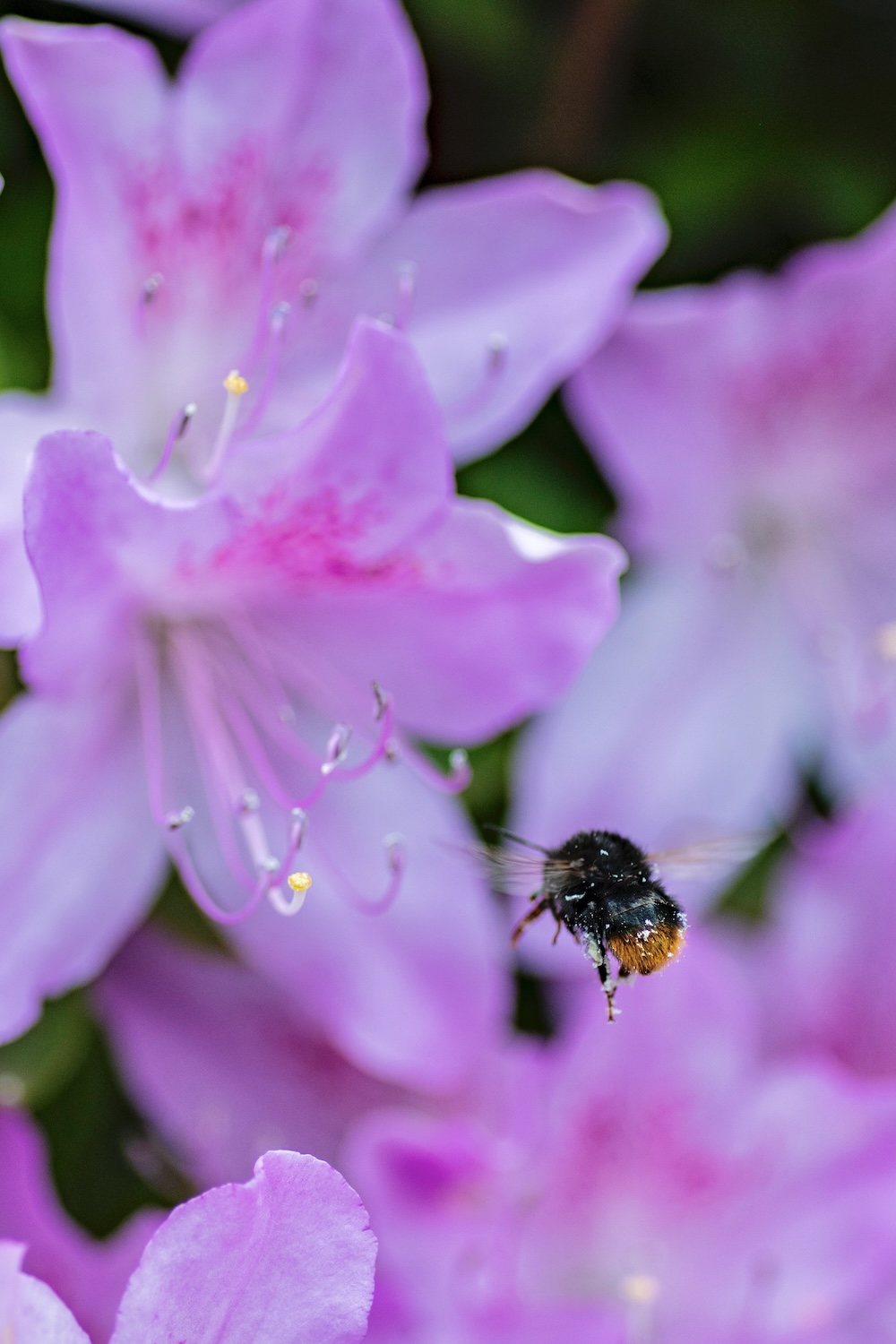
The hornet was so obsessed with the scarlet azalea that it didn’t notice me, its black appendages covered in a layer of pollen so thick and uniform that it looked like it had been born with golden feet. In this state the creature seemed pacific, even friendly, as if I could pet it on the abdomen like my dad used to do to bumblebees.
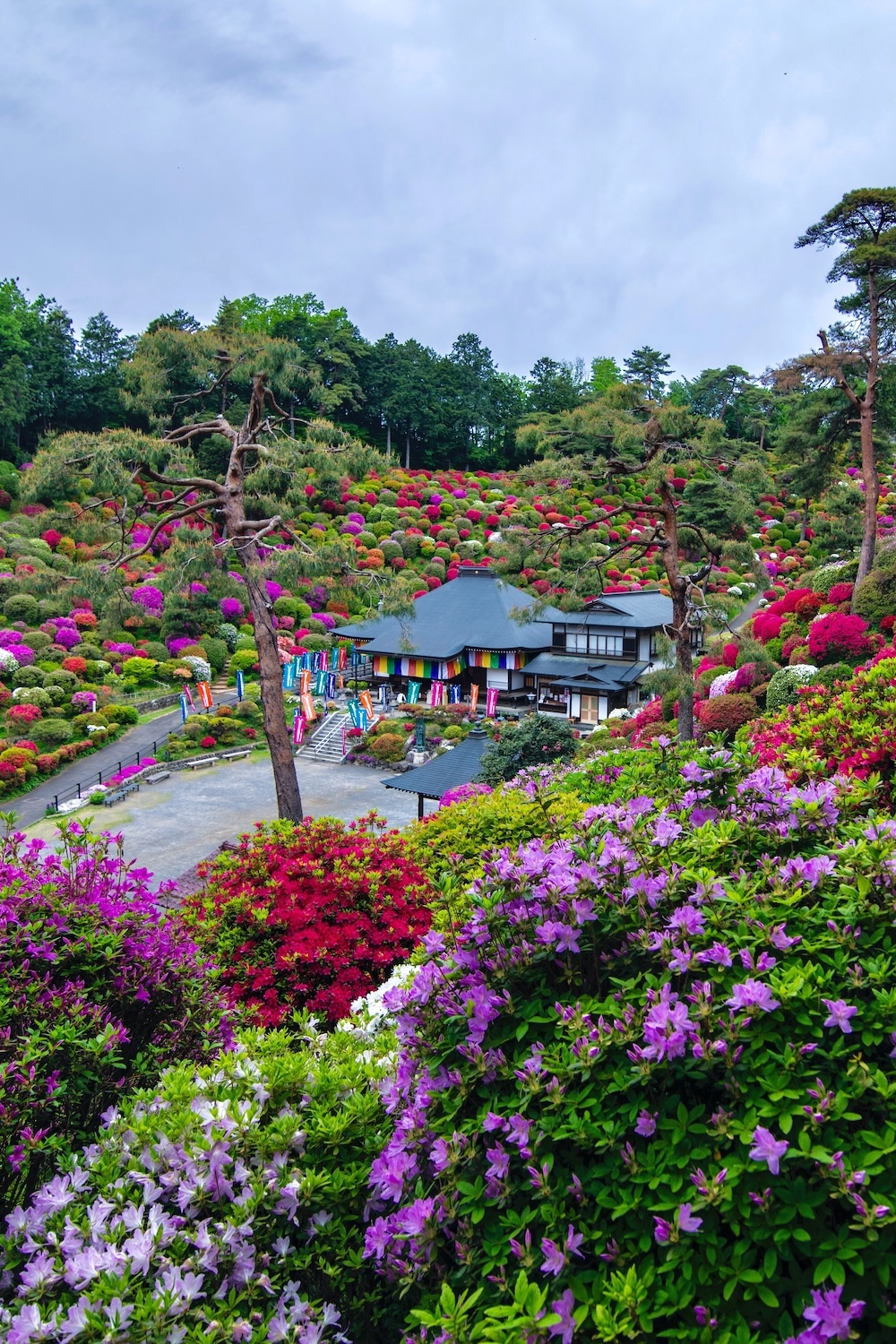
I felt similarly intoxicated as I looked down on the potpourri of tsutsuji bushes coloring the grounds of Shiofune Kannon-ji, a temple in Ome city west of Tokyo, from its bell tower. During the last week of April (or so) every year, the temple goes from anonymous to a head-turner.
For my part, the love-drunk state of being there left me in made me significantly more polite than I normally am: At least twice as much “dozo” and “gomen nasai“; no one asked me to take their picture, that I can recall, though I have no doubt that I would’ve replied in the affirmative, as I had with Junko back in Achi.
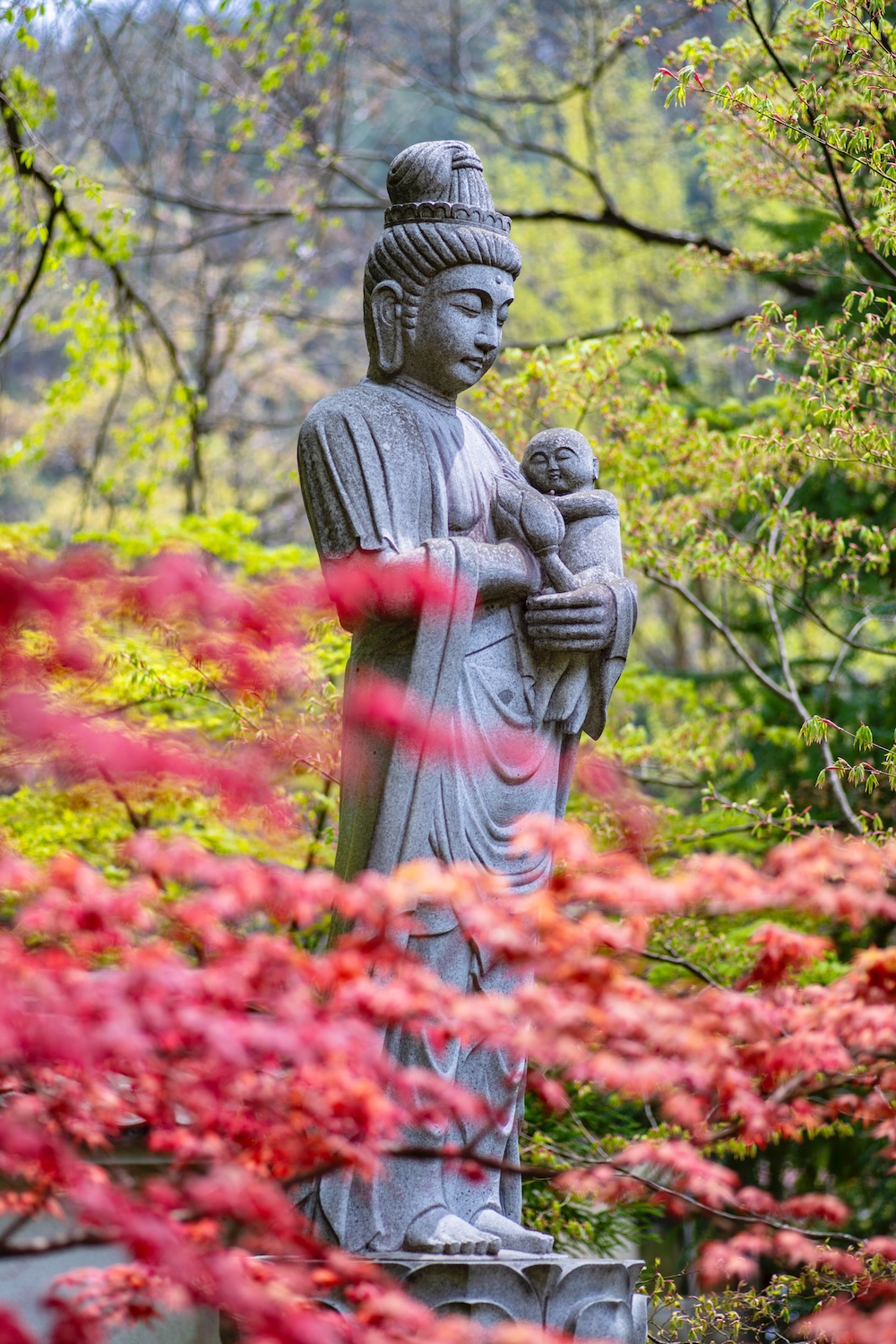
While we were standing at the food of the Kannon statue from which the temple takes its name, a local man did chat me up about America; he mentioned the Grand Canyon when I told him I was from St. Louis. “No!” he made an “X” with his arms when I asked him whether he’d actually been there; he’d simply mentioned it to signal his knowledge of my country.
Just then, the smell of rain hit me hard, even before I felt a single drop. For some reason, it didn’t bother me today. If anything, a blue sky would’ve diluted the proverbial rainbow peppering the hills around the site.
But the ame, when it arrived, did signal to me that it was time to move onto my next destination: Tatebayashi city’s Tsutsujigaoka Park which, as its name suggests, is also an azalea hub.
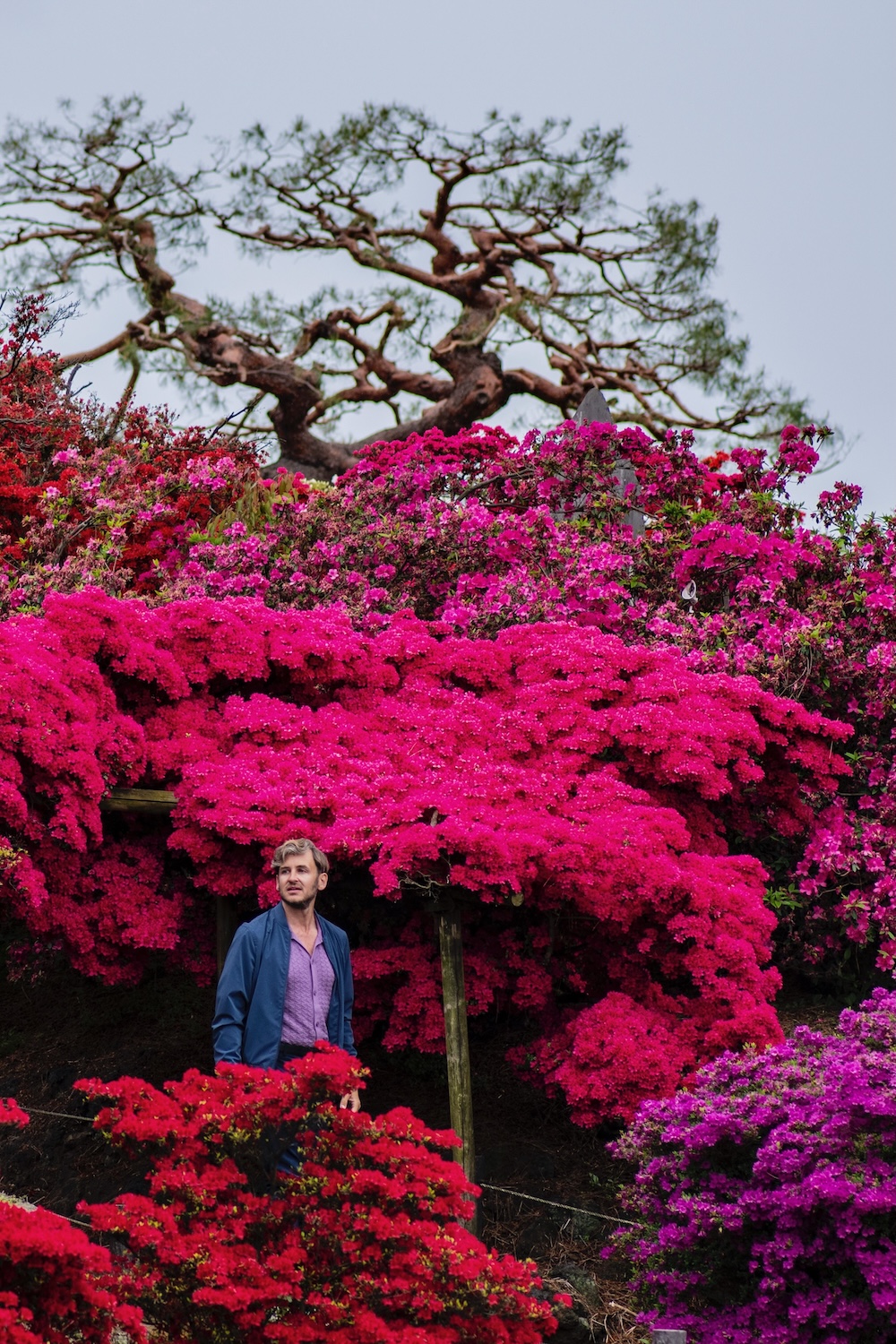
To an outsider, this might seem redundant, but each experience was singular. At Tsutsujigaoka, there isn’t a single postcard-perfect view, or even a viewpoint. Rather, vast expanses of azaleas (with pines dotted in here and there) cover two small hills; both the size and shape of the bushes is more impressive here than at Shiofune Kannon-ji, the colors more varied and, in some cases, unusual.
Here, too, I listened for signals. An “Amazing Grace” ringtone blared out (in MIDI, I assume on some old lady’s fliphone) just as I had seemed to find my photography groove; heavier and more frequent drops seemed to follow almost immediately.
At the time, of course, this was slightly disappointing: I had no guarantees that my third and final destination of the day (Ashikaga Flower Park, down the road in Tochigi prefecture) would live up to the splendor of the first two.
I’d actually been there (to Ashikaga, this is) before, in 2023; unfortunately, I’d arrived just after its famous wisteria had peaked, which left my entire trip feeling pointless. Needless to say, this was not the case in 2026.
I could see from the parking lot, for one, that the flowers were in prime condition; their perfume came over me before I even bought my ticket, priced this year at a steep ¥2,300 to reflect the full-bloom status.
Initially, I thought that my arrival at the first of its three “grand” trees (the oldest of which is 160 years) would be the emotional apex of my visiting to the hanazono, where I’d need to stay for at least three more hours while I waited for it all to illuminate.
Instead, with every step I pushed deeper into it, my delight unfurled further. Many of the “ordinary” wisteria trees, for example, presented themselves as perfumed purple (and, in some cases, white) galaxies; it was almost as if their branches, which twisted behind cascades of perfect petals, were arms reaching out to drag me into their orbits.
Then, there was the grand wisteria trellis itself, where not one but two massive, ancient specimens had grown together into a staggering scaffolding. It was at least an hour before sunset by the time I arrived here, but they’d already illuminated, albeit not to much effect.
As I sat in a cafe eating fuji-flavored soft cream, the conversations around me almost exclusively in Cantonese (I mean, I’ve never seen a wisteria vine in Hong Kong), I felt fundamentally satisfied—and not just for the “triple crown” of perfect flower viewing experiences that had defined my rainy day.
No, when it came to Ashikaga in particular, I could simply have rested on my laurels, and allowed to conclusion I’d drawn about the place three years earlier to be my last word on it. But Japan has a way of compelling kaizen; improvement is all but guaranteed (but certainly not automatic) if you spend enough time here.
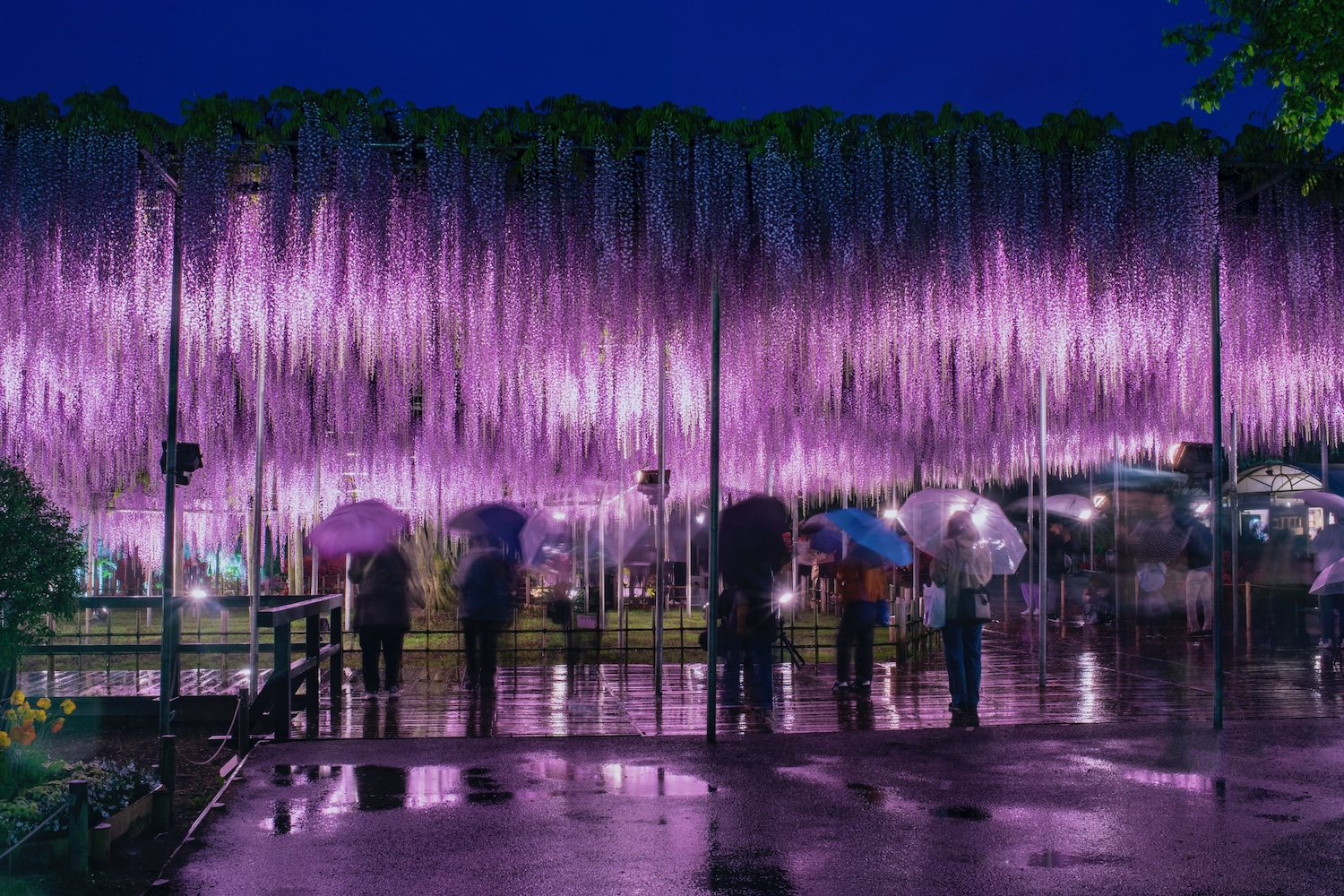
Not automatic, I sighed as I arrived the next morning at Tokyo’s Nezu Shrine, certainly.
I’d been here a year earlier just before peak; my experiences outside of Tokyo a day earlier had led me (misled me, perhaps) into thinking that Nezu-jinja would be at or just past full bloom. Instead, the bushes were almost entirely green, which was fine: I got there before the Tsutsuji Matsuri officially opened, so it’s not as if I would’ve been allowed to enter anyway.
Likewise, the fuji of Kameido Shrine just west of the city center was almost entirely devoid of flowers; there were just enough for me to get placeholder shots prior to 2027 or 2028, when I would hopefully kaizen my way to full bloom framing the twin vermillion bridges of the jinja, and of Tokyo Skytree towering over them.
As I departed the next morning for Ibaraki prefecture’s Hitachi Seaside Park, to be sure, I wondered whether this second “lobe” of my stint in the Tokyo area wouldn’t end up being a mirror image—three strikes; you’re out—of my first.
Like Ashikaga, I’d also previously been to Hitachi’s Kaihin Koen (just before it peaked, in this case); I feared as my arrival beckoned that I might have to return at some point in the future, that I would need to hope for the third time to be the charm.
You’re exhausted, I reminded myself as I sat on the Tokiwa Limited Express bound for Katsuta Station, the closest one to the park. You could barely wake up this morning—maybe the reprieve is a gift. I also took comfort in what a good hair day I was having, even if I would’ve been a shame not to photograph it, full bloom or not.
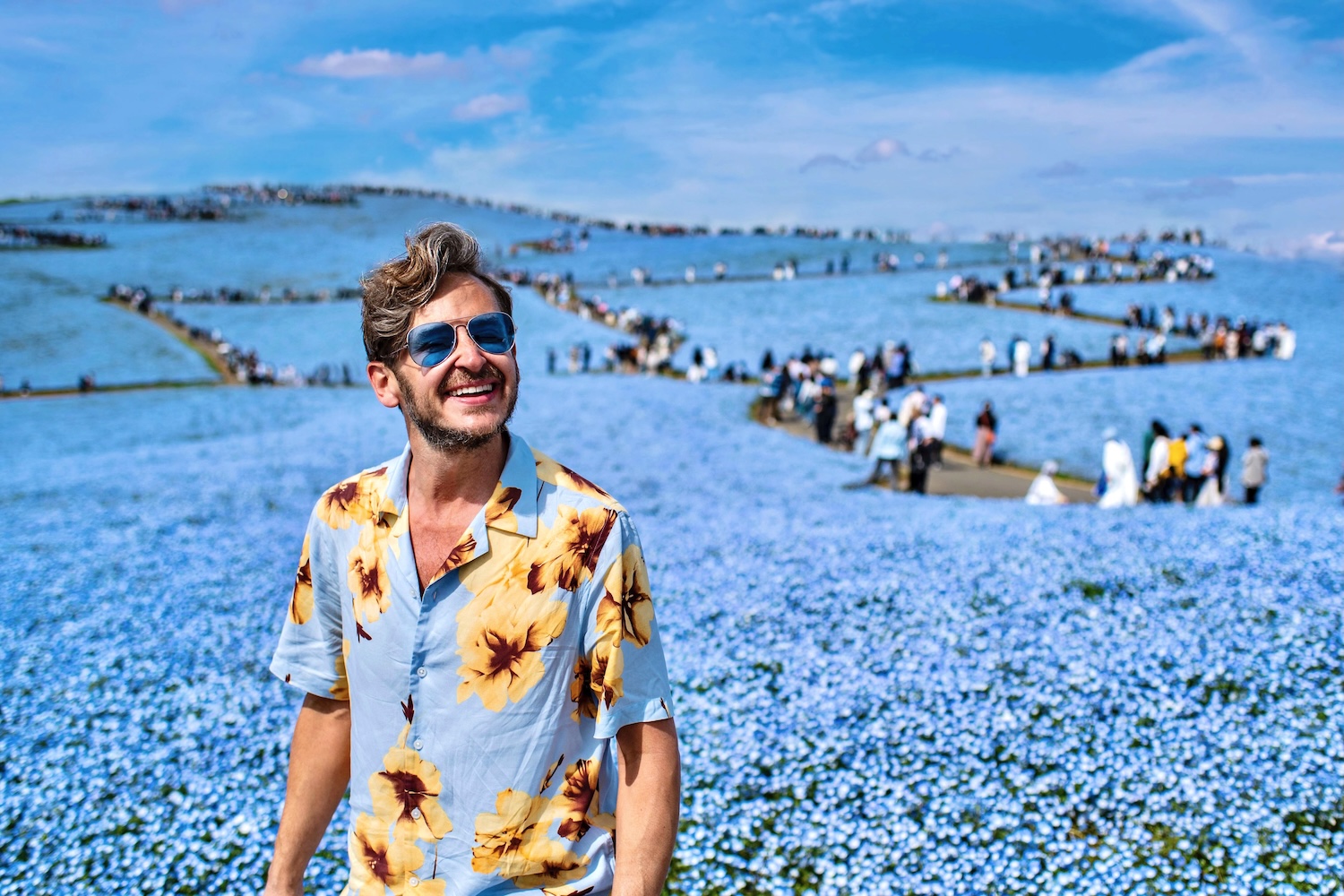
Now, the park (specifically Miharashi Hill, the only part of it where the nemophila “baby blue eyes” are found) was at mankai; at the same time, there really is no such thing as perfect, uniform full bloom around a site so sprawling, even if a greater percentage of the flowers were at their most voluptuous now than had been the case five years earlier.
And this was a delightful reality, and a heartening way to end the main portion of my trip. Which, when I look back on its, has been like many of my “off-year” hanami trips: Tying up loose ends that simply wouldn’t be feasible during the core part of sakura season.
But the real benefit was how the afterglow freed me. At the Art Tower in nearby Mito city, for example, I simply stood back while a father allowed his two young children to play atop its tenbodai, whose low-set “windows” (if you can call them that) are really more useful for people of their height (the kids, this is) than for him or me.
He seemed grateful for my having given way upon elevator. “Do you have one of these?” He asked me on the way down, and presented me with a stylized playing card depicting Mito, one themed to Gundam no less—I shook my head. I held it in my hand for longer than I probably needed to, for several minutes after the young family disappeared from my view (I also let them exit the lift first).
At Mito Station waiting to depart back to the Tokyo area, I found myself almost transfixed on the scene around me, suddenly mindful of each individual around me and curious (but not creepily so) about where they might be headed, about what could be going on in their lives as they boarded the trains passing through as I waited for mine.
Sonder, I plucked the word from the ether, though I couldn’t remember which language it came from—one of the Scandinavian ones, I guessed.
Nor was there a proper Japanese version (they just represent it with katakana), though even sounding out that incarnation of it—son-dā—seemed to evoke intoxicated vespids, azalea forests, wisteria trellises and a hill covered in “baby blue eyes” which, while seemingly identical, each looked in a slightly different direction.
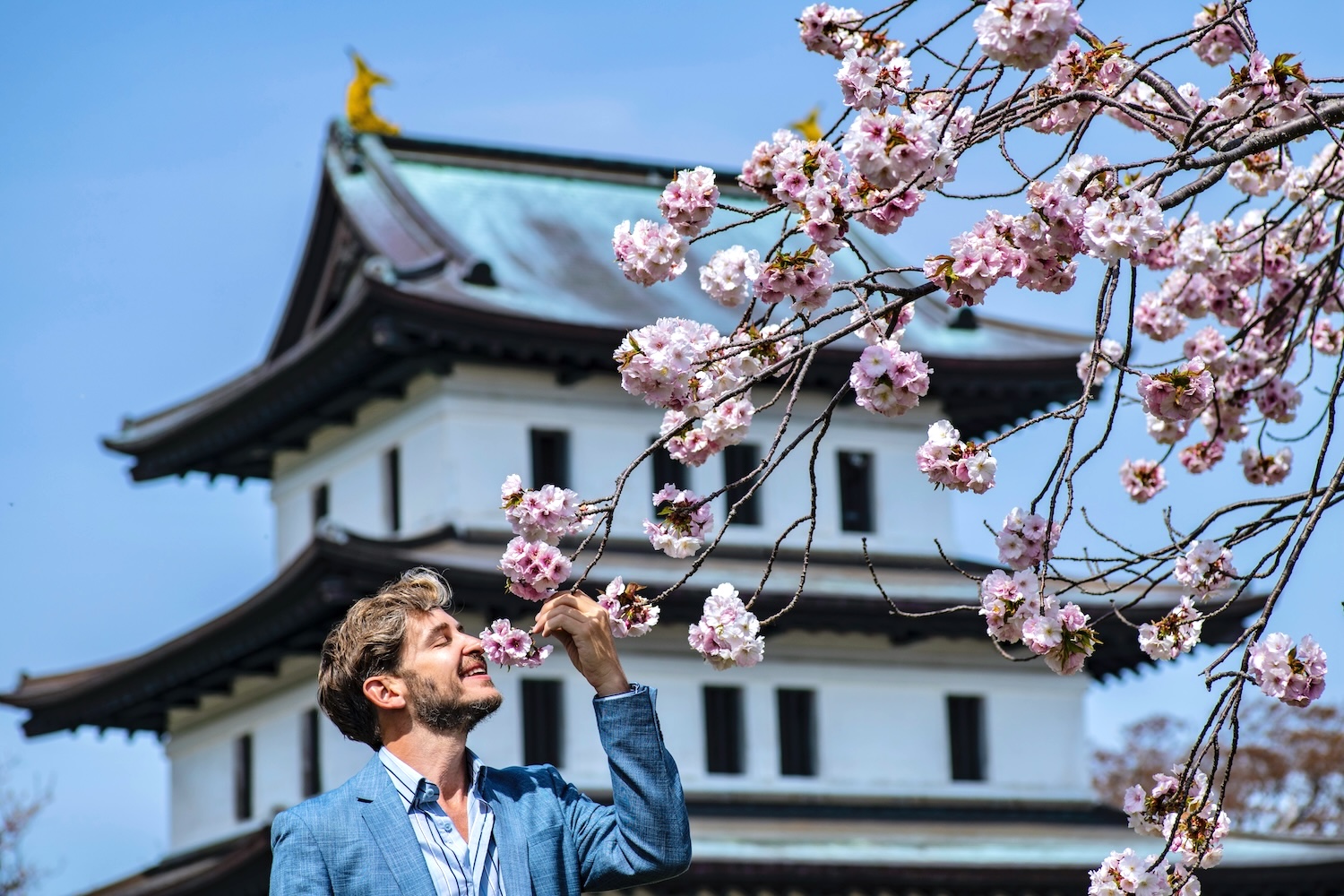
The quantity of blooms at Matsumae-jō, the only Japanese castle on the island of Hokkaido, did not surprise me. I’d seen dozens of trees during my drive there from the Shin-Hakodate-Hokuto Station.
Anyway, I knew that because of the various species of cherry blossoms on offer at the castle (among them both standard somei yoshino, but also “fluffier” kanzanzakura), I’d have at least one last hanami hurrah.
Now, don’t be fooled: This place isn’t Himeji or even Hirosaki; the castle itself is not original (which is evident from the moment you step inside its sterile, poorly-maintained interior); the musicians playing for the matsuri crowd in the courtyard were doing their best, but they won’t be winning any awards.
The town of Matsumae, for its part, was alluring, at least from what I could see of it during my brief time there. I enjoyed a wide view of the castle in context from the balcony of the local Michi-no-eki, waves from the Tsugaru Strait crashing on rocks that looked almost patinated; I turned around and saw the northern coast of Honshu in the distance.
Walking back to my car, I noticed a tree in particularly full bloom, with one branch at precisely the level of my face. I put my nose right in a cluster of blossoms—it sounds almost erotic, doesn’t it?—and inhaled as deeply as I could. It brought me back to my encounter with the great weeping cherry of Kesennuma.
Some years’ sakura blooms are early—some tides come back in as tsunami. Life happens on its own terms, but for most of us, it does go on.